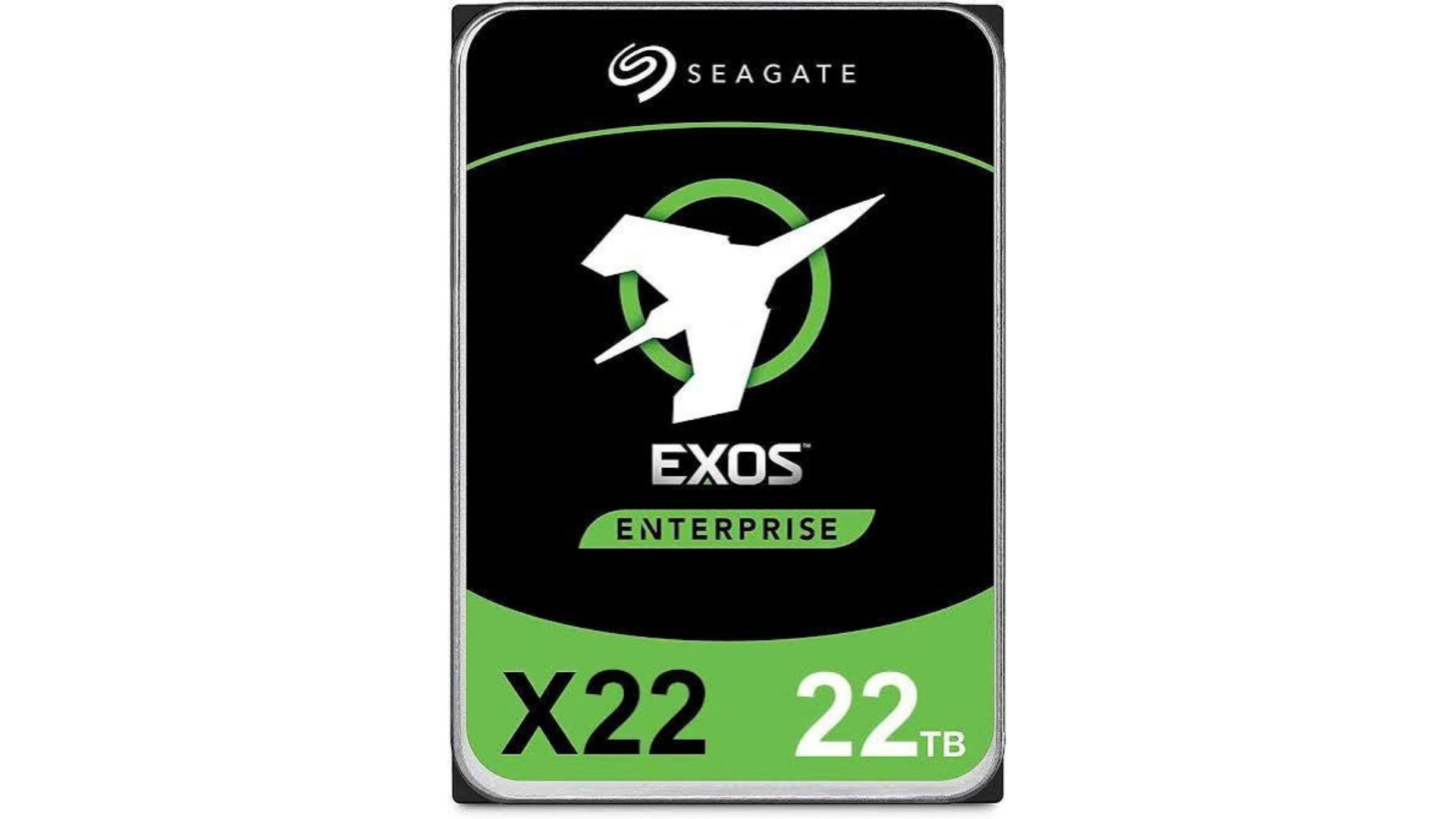
22 TB Capacity (42,970,644,480 Sectors)
3.5-inch Standard LFF • SATA 6 Gb/s Revision 3.3 • 7200 RPM
Conventional Magnetic Recording (CMR) • 10 Platters / 20 Heads
Museum Inventory: 3 Units in Active 24/7 Service (QNAP TS-873A RAIDZ1 Pool)
Authorities: Seagate Engineering Datasheets • StorageReview • ServeTheHome
The Seagate Exos X22 ST22000NM001E-3H represents the pinnacle of hyperscale datacenter mechanical storage engineering. Built upon an industry-first 10-disk, 20-head platform sealed in a helium-purged, hermetically welded enclosure, the Exos X22 delivers an unprecedented 22 Terabytes (22,000,000,000,000 bytes) of raw conventional magnetic recording (CMR) storage in a standard 3.5-inch 26.11 mm form factor. Unlike shingled media (SMR), the drive provides non-penalized random and sequential write dynamics required for mission-critical enterprise workloads, high-throughput streaming repositories, and clustered ZFS pools.
Within Mateo’s Museum and homelab infrastructure, three physical Exos X22 units (serial numbers ZX257FAA, ZX25CYYH, and ZX25FA0P) operate in continuous 24/7 production inside the QNAP TS-873A NAS (eve). Aggregated into a three-drive ZFS RAIDZ1 pool (zpool2) providing 59.9 TB raw storage, these drives back the authoritative R5TB66 bulk media library (/share/ZFS23_DATA), hosting master 4K/8K video vaults and radio audio streaming workspaces.
1. Technical Overview & Comprehensive Specifications
The following engineering matrix details the physical, mechanical, electrical, and telemetry characteristics of the Seagate Exos X22 ST22000NM001E enterprise hard drive:
| Category | Hardware Property | Engineering Specification |
|---|---|---|
| Drive Identity & Platform | Brand & Family | Seagate Exos Enterprise Storage |
| Commercial Model Name | Exos X22 (Standard FastFormat) | |
| Exact Part / Model Number | ST22000NM001E-3H (OEM / Channel Enterprise) |
|
| Target Market Segment | Hyperscale Datacenters, Enterprise Cloud Storage, High-Density NAS | |
| Form Factor | 3.5-inch Low Profile (26.11 mm z-height • 101.85 mm width • 147.0 mm length) | |
| Drive Weight | 670 g (1.477 lb) | |
| Platter & Head Subsystem | Platter Configuration | 10 Disks (Aluminum-Magnesium substrate with magnetic recording layers) |
| Read / Write Heads | 20 Heads (Two heads per platter with dual-stage micro-actuation) | |
| Internal Gas Environment | Helium (Purged, hermetically wide-welded sealed enclosure) | |
| Recording Technology | Conventional Magnetic Recording (CMR / PMR) | |
| Areal Density | Approx. 1,100 Gb/in² (gigabits per square inch) | |
| Track Density | Approx. 1,300 kTPI (thousand tracks per inch) | |
| Spindle Rotational Speed | 7,200 RPM (Rotations Per Minute • 120 Hz) | |
| Performance & Throughput | Host Bus Interface | SATA 6 Gb/s (SATA Revision 3.3, backward compatible with 3 Gb/s & 1.5 Gb/s) |
| Maximum Sustained Transfer Rate | Up to 285 MB/s (Outer Diameter zone) | |
| Average Rotational Latency | 4.16 ms | |
| Average Read / Write Seek Time | Approx. 4.16 ms read seek / 4.40 ms write seek | |
| DRAM Multi-Segmented Cache | 512 MB High-Speed DDR4 SDRAM Buffer | |
| Random Read IOPS (4KB QD16) | Approx. 168 IOPS (steady-state across drive span) | |
| Random Write IOPS (4KB QD16) | Approx. 550 IOPS (with internal write cache enabled) | |
| Reliability & Longevity | Annualized Workload Rating (WRL) | 550 TB/year (24×7 enterprise continuous duty cycle) |
| Mean Time Between Failures (MTBF) | 2,500,000 hours (2.5 million hours) | |
| Annualized Failure Rate (AFR) | 0.35% (at continuous 8,760 power-on hours per year) | |
| Unrecoverable Bit Error Rate (UBER) | < 1 sector per 10^15 bits read | |
| Load / Unload Cycles | 600,000 cycles (ramp load mechanism) | |
| Manufacturer Warranty | 5 Years Limited Enterprise Warranty | |
| Electrical & Acoustic | Power Supply Rails | Dual-rail DC (+5V ± 5% / +12V ± 10%) |
| Typical Idle Power Consumption | 4.4 W (spindle spinning at 7200 RPM in ready state) | |
| Max Operating Power Draw | 9.4 W (random read/write enterprise workload) | |
| Acoustics (Idle / Seek Sound Power) | Typ. 2.8 bels idle / 3.2 bels seek (fluid dynamic bearing motor) | |
| Operating Temperature Range | 5°C to 60°C (Baseplate thermal operating range) | |
| Enterprise Technologies | PowerChoice Technology | Multi-tier idle state management (Idle A, B, C, D power stepping) |
| PowerBalance Technology | Firmware-controlled balanced IOPS-per-Watt performance curve | |
| Error Recovery Control (ERC / TLER) | Configurable command recovery timeout (avoids RAID/ZFS drive dropouts) | |
| Sector Format (FastFormat) | Factory 512e (512-byte emulation); field reconfigurable to native 4Kn | |
| Helium Environmental Monitoring | Digital environmental sensors monitoring internal pressure and hermetic seal |
2. Mechanical Architecture & Helium Hermetic Seal Engineering
To pack 22 Terabytes into a standard 1-inch (26.11 mm) 3.5-inch desktop drive footprint without relying on shingled tracks, Seagate pioneered an ultra-dense 10-platter, 20-head mechanical platform. In conventional air-filled hard drives, aerodynamic drag and turbulent airflow generated by rapidly spinning platters induce mechanical flutter on the disk surfaces and buffeting on the suspension arms. This turbulence imposes a hard physical ceiling of approximately 5 to 7 platters in an air enclosure before track-following accuracy deteriorates beyond recoverable limits.
The Exos X22 overcomes these physical boundaries through complete immersion in high-purity Helium gas. Because helium possesses an atomic mass of 4 (compared to an effective molar mass of ~28.8 for ambient air), its density is approximately one-seventh (1/7th) that of air. This dramatic reduction in fluid density yields profound engineering advantages:
- Turbulent Drag Elimination: Aerodynamic buffeting on the 20 read/write heads and 10 platters is slashed by nearly 85%, allowing platters to be made thinner and stacked closer together while maintaining ultra-precise head positioning along micro-tracks measuring less than 20 nanometers wide.
- Substantial Motor Power Reduction: Less aerodynamic drag reduces the mechanical resistance against the spindle motor. The Exos X22 idles at just 4.4 Watts, whereas older 4 TB and 8 TB air-filled enterprise drives routinely required 7 to 9 Watts at idle.
- Superior Thermal Dissipation: Helium has a thermal conductivity nearly six times greater than air, efficiently transferring heat away from internal motors, actuator coils, and drive ASIC silicon to the cast aluminum chassis.
- Hermetic Wide-Weld Seal: The drive housing is hermetically sealed via an automated laser wide-weld around the perimeter of the forged aluminum base and top cover. Digital internal pressure sensors continuously monitor the internal helium environment throughout its 2.5 million-hour design lifespan.
3. Monospace ASCII Storage Topology & Block Diagram
The following architectural schematic illustrates the complete hardware topology from the host SATA controller through the drive electronics, multi-segmented cache, 20-head actuator assembly, and the QNAP ZFS RAIDZ1 pool configuration:
+-----------------------------------------------------------------------------------------------------------------------+
|                                    SEAGATE EXOS X22 (ST22000NM001E-3H) ARCHITECTURAL SCHEMATIC                         |
+-----------------------------------------------------------------------------------------------------------------------+
|                                                                                                                       |
|  [ HOST SYSTEM INTERFACE ]                                                                                            |
|   +-- QNAP TS-873A NAS (AMD Ryzen Embedded V1500B Quad-Core SoC)                                                      |
|       +-- SATA Controller: 6 Gb/s AHCI Host Bus Adapter (Native Command Queuing, up to 32 commands)                   |
|           `-- High-Speed SATA Differential Signal Lines (TX± / RX±) • 600 MB/s PHY Burst Rate                       |
|                                                                                                                       |
|  [ DRIVE CONTROLLER PCB SILICON ]                                                                                     |
|   +-- Seagate Custom Controller ASIC (Dual-Core ARM Cortex-R Architecture)                                            |
|   |   +-- Read/Write Channel & LDPC Advanced Error-Correction Engine                                                  |
|   |   +-- Servo Tracking Processor (Rotational Vibration Sensor Feed-Forward Matrix)                                 |
|   |   `-- FastFormat Translation Layer (Dynamic 512e Emulation <---> Native 4Kn Formatting)                         |
|   |                                                                                                                   |
|   +-- Volatile Buffer: 512 MB DDR4 Multi-Segmented Cache SDRAM                                                        |
|   |   +-- Read-Ahead Prediction Engine & Command Tag Reordering Queue                                                 |
|   |   `-- Write-Back Cache Coalescing Buffer (Protected by PowerLoss Emergency Head Unload)                         |
|   |                                                                                                                   |
|   `-- Motor & Voice Coil Driver: Smooth-Drive Dynamic Spindle Controller (7,200 RPM • Fluid Dynamic Bearing)         |
|                                                                                                                       |
|  [ HERMETICALLY SEALED HELIUM CHAMBER (10 PLATTERS / 20 READ-WRITE HEADS) ]                                            |
|   +-- Precision Laser Wide-Weld Seal (Atmospheric Helium Retention • Digital Hermetic Pressure Sensors)              |
|   +-- Dual-Stage Actuator (DSA): Voice Coil Actuator (Coarse) + Piezoelectric Micro-Actuator (Fine Track)             |
|   |   +-- Head Arm Stack (20 Head Gimbals • Low-Fly-Height Heat-Assisted / Tunneling Magnetoresistive TMR Heads)     |
|   |   |   |-- Head 00 / 01  ====> Platter 01 (Aluminum-Magnesium Substrate • CMR Magnetic Media • 2.2 TB/disk)      |
|   |   |   |-- Head 02 / 03  ====> Platter 02                                                                          |
|   |   |   |-- Head 04 / 05  ====> Platter 03                                                                          |
|   |   |   |-- Head 06 / 07  ====> Platter 04                                                                          |
|   |   |   |-- Head 08 / 09  ====> Platter 05                                                                          |
|   |   |   |-- Head 10 / 11  ====> Platter 06                                                                          |
|   |   |   |-- Head 12 / 13  ====> Platter 07                                                                          |
|   |   |   |-- Head 14 / 15  ====> Platter 08                                                                          |
|   |   |   |-- Head 16 / 17  ====> Platter 09                                                                          |
|   |   |   `-- Head 18 / 19  ====> Platter 10                                                                          |
|                                                                                                                       |
|  [ QNAP HOMELAB DEPLOYMENT (3 UNITS IN ZFS RAIDZ1) ]                                                                  |
|   +-- /dev/sda (S/N: ZX257FAA) --+                                                                                    |
|   +-- /dev/sdb (S/N: ZX25CYYH) --+===> zpool2: ZFS RAIDZ1 Storage Pool (59.9 TB Raw • 37.2 TB Active Allocation)       |
|   +-- /dev/sdc (S/N: ZX25FA0P) --+     `-- Mountpoint: /share/ZFS23_DATA (Dataset: R5TB66 Media & Archive Vault)       |
+-----------------------------------------------------------------------------------------------------------------------+
4. Magnetic Recording Physics: CMR vs. SMR in ZFS Environments
In modern enterprise storage, understanding recording physics is critical for system stability. Hard drive manufacturers have increasingly split the market between two contrasting recording architectures:
- Conventional Magnetic Recording (CMR / PMR): In the Exos X22, data tracks are written parallel to one another with discrete physical guard bands separating adjacent tracks. Because tracks do not overlap, write operations to a specific sector do not alter or corrupt adjacent physical tracks. Random writes are executed with deterministic seek and write latencies.
- Shingled Magnetic Recording (SMR): In SMR drives, tracks overlap like shingles on a roof to artificially increase track density. However, writing to an overlapping track partially overwrites neighboring tracks, requiring entire multibigabyte “bands” to be read into cache, modified, and rewritten sequentially.
In enterprise ZFS storage environments like QuTS hero on the QNAP TS-873A, CMR architecture is non-negotiable. When ZFS performs transactional copy-on-write operations, scrub validation, or resilvering after drive replacement, random 4KB to 128KB block writes saturate the drive. On an SMR drive, internal write cache exhaustion causes write operations to stall for tens of seconds. Host RAID controllers and ZFS software layers interpret these massive latency spikes as hardware timeouts, dropping the drive from the pool and causing catastrophic cascading array failure. The Exos X22’s pure CMR architecture ensures consistent, sub-10ms write responsiveness under full-span saturation.
Additionally, the drive features FastFormat™ technology. While delivered from the factory configured with 512-byte logical emulation (512e) to maintain backward compatibility with legacy operating systems, the drive can be re-initialized into native 4096-byte logical sectors (4Kn). This eliminates the 512-byte emulation translation layer, aligning physical magnetic sectors 1:1 with ZFS ashift=12 pools for optimal throughput and zero read-modify-write performance penalties.
5. Enterprise Reliability, PowerChoice & Error Recovery Control (ERC)
Unlike consumer-grade desktop hard drives designed for intermittent PC use, the Exos X22 incorporates specialized firmware protocols tailored for multi-drive enterprise enclosures:
- Error Recovery Control (ERC / TLER): Desktop hard drives (such as Seagate Barracuda or Western Digital Blue) are programmed to aggressively attempt sector recovery when a bad block is encountered, often retrying for 30 to 120 seconds. In a RAID or ZFS array, host controllers will mark a drive as dead if it does not respond within 8 seconds, causing unnecessary drive dropouts. The Exos X22’s ERC feature limits internal drive error recovery to approximately 7 seconds, immediately returning a read error to the host so ZFS can transparently reconstruct the unreadable block from parity and re-write it to a healthy sector.
- PowerChoice™ Idle Technology: Datacenter deployments experience fluctuating workloads. PowerChoice enables four progressively deeper idle power states (Idle A through D), reducing spindle motor RPM and unloading the head stack to parking ramps during quiet periods. This reduces power consumption from 4.4 W down to under 1.5 W per drive while maintaining rapid sub-second wake-up latencies.
- Rotational Vibration (RV) Feed-Forward Sensors: In high-density NAS systems holding up to 8 or 16 drives in a single chassis, harmonic vibration from neighboring drives and cooling fans can throw read/write heads off track. The Exos X22 features onboard RV sensors that detect angular acceleration and feed real-time correction vectors to the dual-stage voice coil actuators, maintaining 99%+ throughput in high-vibration chassis.
6. Real-World Throughput, IOPS & Command Queuing
Hard drive transfer rates are dictated by rotational geometry. Because the platters rotate at a constant angular velocity (7,200 RPM • 120 rotations per second), data sectors passing beneath the read/write heads move faster along the outer perimeter of the disk than near the central spindle:
- Outer Diameter (OD) Peak Throughput: 285 MB/s sequential read and write speeds across the first several terabytes of the address space.
- Inner Diameter (ID) Sustained Throughput: Approximately 140 MB/s sequential transfer rate at the innermost tracks.
- Native Command Queuing (NCQ QD32): Supports deep 32-command hardware queues, allowing the internal ASIC to dynamically reorder read/write requests to follow the shortest rotational seek path, boosting random IOPS throughput by up to 25% over non-queued architectures.
7. Curator’s Assessment & Homelab Integration
The three Seagate Exos X22 drives serve as the high-capacity backbone of the CZ-BRN-NEU primary storage array inside the QNAP TS-873A. Connected via physical drive slots 5, 6, and 7, the drives form the ZFS RAIDZ1 storage pool zpool2:
- Total Raw Capacity: 59.9 TB (42,970,644,480 sectors per drive • 20.01 TiB usable per disk).
- Effective Fault Tolerance: Single-parity ZFS RAIDZ1, allowing any single 22 TB drive to suffer complete catastrophic hardware failure without loss of data.
- Authoritative Dataset Role: Hosts the
R5TB66bulk data library (/share/ZFS23_DATA), storing uncompressed 4K/8K media streams for Plex and Jellyfin, digitized retro software repositories, and long-term Proxmox Backup Server (PBS) archives. - Quiet Hours & Scrub Scheduling: To mitigate acoustic resonance in the home environment, QuTS hero pool scrubbing and automated smart maintenance are strictly scheduled during early morning quiet hours, ensuring silent daytime operation while maintaining continuous bit-rot validation.
- Thermal Profiles: In the QNAP’s dual-chamber acoustic enclosure, the three helium-sealed drives maintain steady operating temperatures between 34°C and 41°C, significantly cooler than equivalent air-filled drives operating under continuous duty.
8. Authentic Hardware Provenance & Physical Drive Telemetry
The following serial numbers and hardware parameters document the three physical Exos X22 drive exhibits currently in live museum and homelab service:
| Drive Unit | Device Path | Serial Number | Firmware | Total 512-Byte Sectors | Array Assignment & Health |
|---|---|---|---|---|---|
| Unit 1 | /dev/sda |
ZX257FAA |
SN01 |
42,970,644,480 sectors (22 TB) | ZFS zpool2 RAIDZ1 Member • Passed (0 errors • 37°C) |
| Unit 2 | /dev/sdb |
ZX25CYYH |
SN01 |
42,970,644,480 sectors (22 TB) | ZFS zpool2 RAIDZ1 Member • Passed (0 errors • 38°C) |
| Unit 3 | /dev/sdc |
ZX25FA0P |
SN01 |
42,970,644,480 sectors (22 TB) | ZFS zpool2 RAIDZ1 Member • Passed (0 errors • 36°C) |
9. Related Museum Storage Exhibits
Explore related storage hardware exhibits and systems across the collection:
- Master Collection Catalog: Mateo’s Museum Storage Collection
- Host NAS System: QNAP TS-873A AMD Ryzen Quad-Core 2.5GbE NAS
- Enterprise SATA SSD Exhibit: Micron 5210 ION 1.9 TB Enterprise SATA SSD
- High-Endurance Datacenter SSD: Intel SSD DC S3710 Series 800GB Enterprise SSD
- 10,000 RPM Spindle Exhibit: Western Digital VelociRaptor WD3000GLFS 300 GB 10K RPM
- Desktop 7200 RPM Hard Drive: Toshiba P300 HDWD105 500 GB 7200 RPM Hard Drive
- Vintage SCSI Fixed Disk: Atari Megafile 30 External Hard Disk