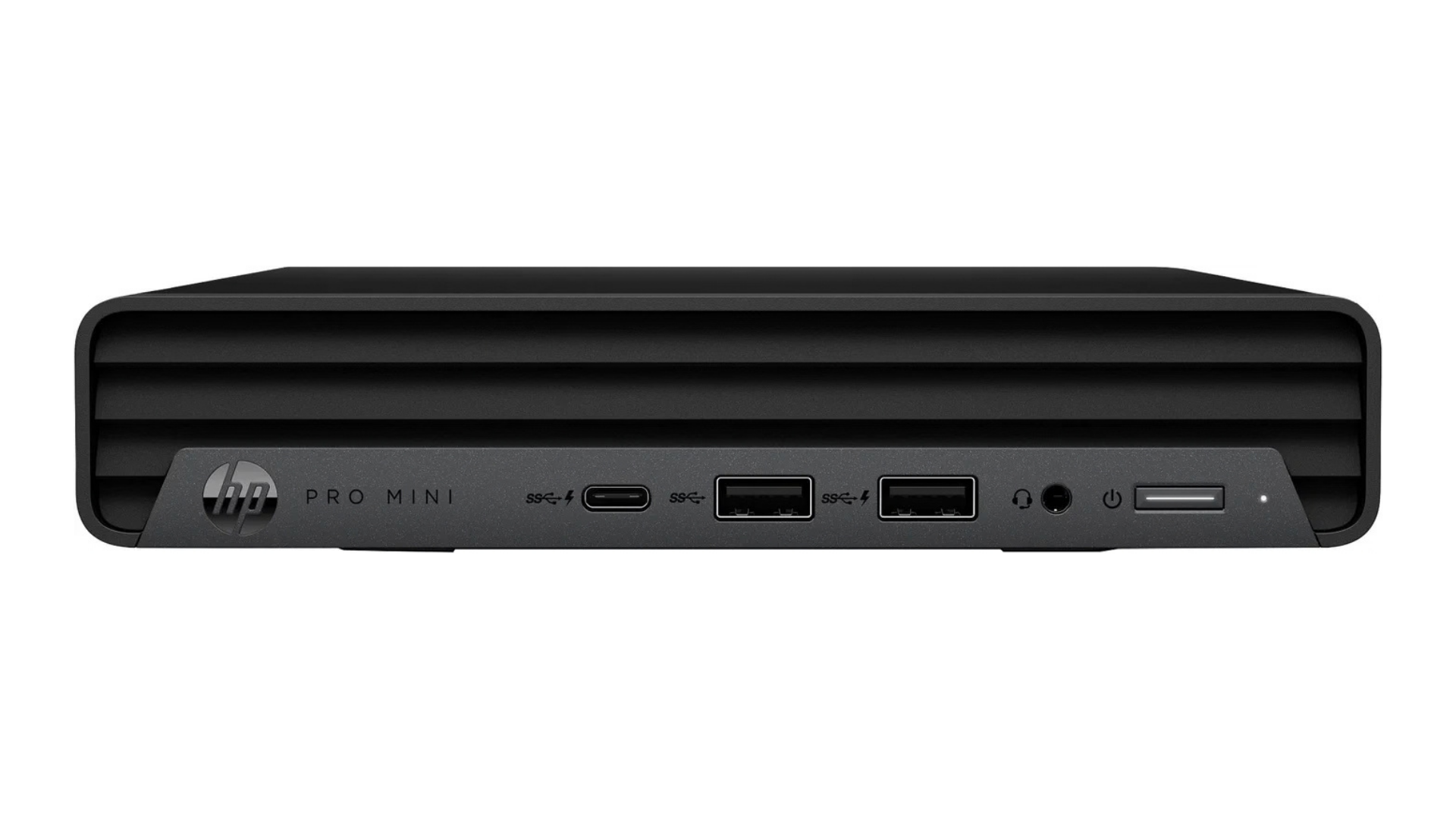
HP Pro Mini 400 G9 Desktop PC
- Operating system: Proxmox VE 9.2.0 (pve-manager
9.2.20/49318c671b82f31e, Linux Kernel7.0.14-19-pve, Debian GNU/Linux 13 trixie, x86_64) - Processor: 13th Gen Intel® Core™ i5-13500T (up to 4.60 GHz P-core / 3.20 GHz E-core, 24 MB Intel Smart Cache, 14 cores, 20 threads)
- CPU Type: 6P+8E Intel Core i5-13500T, Raptor Lake hybrid architecture (Intel 7 process, 35W processor base power, 92W maximum turbo)
- Motherboard Name: HP Pro Mini 400 G9 Desktop PC
- Model: HP Pro Mini 400 G9 Desktop PC (SKU:
D8LM2ET#BCM, DMI:SBKPFV3, Family:103C_53307F HP ProDesk) - Baseboard: HP
8AC9(KBC Version12.03.55, Baseboard Serial:PQZZC0I87M82QI) - Motherboard Chipset: Intel® Q670 Chipset eSPI Controller (PCI
8086:7a83, vPro® capable) - Graphics: Integrated Intel® UHD Graphics 770 (Alder Lake-S GT1, 32 EUs, PCI
8086:4680rev 0c,i915driver, dual QuickSync video engines) - Memory: 64 GB DDR4-3200 MT/s (2 × 32 GB Corsair Vengeance SODIMMs, Dual-Channel active)
- Memory Slots: 2 SODIMM (Dual-Channel active)
- DIMM1: Corsair
CMSX64GX4M2A3200C22: 32 GB DDR4-3200 SODIMM (Dual-Rank 2Rx8, CL22-22-22-53 @ 1.2V) - DIMM3: Corsair
CMSX64GX4M2A3200C22: 32 GB DDR4-3200 SODIMM (Dual-Rank 2Rx8, CL22-22-22-53 @ 1.2V) - Internal Storage: 512 GB PCIe® Gen4 x4 NVMe™ M.2 SSD 2280
- Disk Drive: HP OEM
PSENN512GA87QC0(Phison PS5027-E27T PCIe4 NVMe Controller, 512 GB, SMART health passed, 100% available spare) - Storage Expansion: Internal SATA0 connector available for standard 2.5″ SATA SSD/HDD caddy
- Dimensions & Weight: 17.7 × 17.5 × 3.4 cm (1-Liter Ultra-Slim UCFF chassis), net weight approx. 1.25 kg
- Wireless: Intel® Wi-Fi 6 AX201 (160MHz) and Bluetooth® 5.2 wireless card (MAC:
64:4a:7d:f9:0d:12) - Network interface: Intel® Ethernet Connection (17) I219-LM GbE (MAC:
b4:e2:5b:3d:18:41, link active at 1000 Mb/s Full-Duplex) - Audio: Intel 600 Series HD Audio Controller (PCI
8086:7ad0rev 11,snd_hda_intel) - USB Controllers: Intel 600 Series USB 3.2 Gen 2×2 (20 Gbps) XHCI Host Controller (PCI
8086:7ae0rev 11,xhci_hcd) - BIOS Version: HP
U23 Ver. 02.21.00(Release Date: 01/09/2026, BIOS Rev: 21.0 / Firmware Rev: 18.3) - Serial Number:
1HF6140NV6 - System UUID:
6a8e05a6-0a9d-4c0e-9260-d7bd89e85c8a - Expansion slots:
- 1 × M.2 2230 (dedicated WLAN / Bluetooth slot, occupied by Intel AX201)
- 1 × M.2 2280 (PCIe Gen4 x4 NVMe slot for solid-state storage)
- 1 × SATA0 SAS/SATA Plug Receptacle (internal 2.5″ drive caddy support)
- Ports:
- Front: 1 × USB Type-C® 20Gbps signaling rate, 2 × USB 3.0 Type-A (10Gbps), 1 × 3.5mm Headset combo audio jack
- Rear: 3 × USB 3.0 Type-A, 1 × HDMI 2.1, 2 × DisplayPort™ 1.4, 1 × RJ-45 Gigabit Ethernet port, 1 × external DC power barrel connector
- Power: External 90 W Smart AC power adapter (19.5V DC output, up to 89% energy efficiency)
- Cluster Role: Active Clustered Node 3 in
cz-brn-neu-pve(3-Node Proxmox VE Cluster, Node ID 3, 1 vote, quorate), replacing legacy Supermicro X8DAH host - Active Guest Workloads: Immich VM
102(IP:192.168.111.77, 160 GB guest disk onlocal-lvm) - Benchmarks:
- PassMark CPU Mark: 22,447 (PassMark CPU Benchmark Baseline #5337)
JEDEC DDR4 SDRAM Standard Speed & Operating Frequency Reference
| Standard | Module Name | Memory Clock (MHz) | I/O Bus Clock (MHz) | Data Rate (MT/s) | Nominal Voltage (V) |
|---|---|---|---|---|---|
| DDR4-1600 | PC4-12800 | 200 | 800 | 1600 | 1.2 |
| DDR4-1866 | PC4-14900 | 233 | 933 | 1866 | 1.2 |
| DDR4-2133 | PC4-17000 | 266 | 1066 | 2133 | 1.2 |
| DDR4-2400 | PC4-19200 | 300 | 1200 | 2400 | 1.2 |
| DDR4-2666 | PC4-21300 | 333 | 1333 | 2666 | 1.2 |
| DDR4-2933 | PC4-23400 | 366 | 1466 | 2933 | 1.2 |
| DDR4-3200 (Active) | PC4-25600 | 400 | 1600 | 3200 MT/s | 1.2 V |
HP Pro Mini 400 G9 – Hardware Telemetry & Diagnostic Report
•
Target Host:
node3 (HP Pro Mini 400 G9 Desktop PC)•
Site: CZ-BRN-NEU (Brno Lab)
•
Verification Date: September 26, 2026
1. System Summary & Computer Overview
| Category | Property | Value |
|---|---|---|
| Computer | Computer Type | ACPI x64-based Ultra-Compact Form Factor (UCFF) Desktop Mini PC |
| Hostname / Role | node3.cogeanu.com (Clustered Proxmox VE Virtualization Node 3 & Immich VM 102 Host) |
|
| System Vendor & Model | HP Inc. • HP Pro Mini 400 G9 Desktop PC (Family: 103C_53307F HP ProDesk) |
|
| Product SKU & Serial | Product ID: D8LM2ET#BCM (DMI: SBKPFV3) • Serial: 1HF6140NV6 |
|
| System UUID | 6a8e05a6-0a9d-4c0e-9260-d7bd89e85c8a |
|
| Motherboard | HP 8AC9 (KBC Version 12.03.55 • Baseboard Serial: PQZZC0I87M82QI) |
|
| Chassis Dimensions & Weight | 1-Liter Ultra-Slim Mini (17.7 × 17.5 × 3.4 cm • approx. 1.25 kg net weight) | |
| Operating System | Primary Hypervisor | Proxmox VE 9.2.0 (pve-manager 9.2.20/49318c671b82f31e) |
| Base OS & Kernel | Debian GNU/Linux 13 (trixie, x86_64) • Linux Kernel 7.0.14-19-pve |
|
| Boot Mode & Security | UEFI Mode • Secure Boot: Disabled • TPM 2.0: Nuvoton NTC0702 Active |
|
| Cluster State | Member of cz-brn-neu-pve (Node ID 3, 1 vote, quorate, 3/3 active nodes) |
|
| Cluster Endpoints | Management LAN: 192.168.111.135/24 on vmbr0 • Web UI: https://192.168.111.135:8006 |
|
| Processors | CPU Sockets | 1 × Socket LGA 1700 |
| Processor Model | 13th Gen Intel(R) Core(TM) i5-13500T (Intel 7 Process, Stepping 2) | |
| Core / Thread Topology | 14 Physical Cores / 20 Threads (6 Performance Cores with HT + 8 Efficient Cores) | |
| Microarchitecture | Raptor Lake Hybrid (Golden Cove P-cores + Gracemont E-cores • 35W Base TDP / 92W Max Turbo) | |
| PassMark Benchmark | 22,447 Average CPU Mark (PassMark CPU Benchmark Baseline #5337) | |
| Memory | Physical Installed RAM | 64.0 GB (2 × 32 GB Corsair Vengeance DDR4-3200 SODIMMs) |
| Module Specification | Corsair CMSX64GX4M2A3200C22 (Dual-Rank 2Rx8, non-ECC unbuffered, 1.2V) |
|
| Configured Operating Speed | 3200 MT/s (PC4-25600) (Full native dual-channel speed • 51.2 GB/s peak bandwidth) | |
| Runtime Usable Memory | 62.0 GiB binary (~67.0 GB decimal) Linux visible RAM + 8.0 GiB Swap | |
| Graphics | Integrated Graphics Processor | Intel® UHD Graphics 770 (Alder Lake-S GT1, 32 EUs @ up to 1,450 MHz dynamic max • i915) |
| Hardware Acceleration | Dual Intel Quick Sync Video engines (Hardware HEVC 10-bit, VP9, and AV1 decode for media workloads) | |
| Physical Display Connectors | 2 × DisplayPort 1.4 + 1 × HDMI 2.1 (supports up to 3 independent digital 4K/8K displays) | |
| Storage | Primary OS & VM Storage | HP OEM PSENN512GA87QC0 512 GB M.2 2280 NVMe SSD (Phison PS5027-E27T PCIe 4.0 x4) |
| Storage Expansion Bay | Internal SATA0 connector ready for 2.5″ SATA SSD/HDD installation | |
| Storage Subsystem Health | SMART Passed • 0 media errors • 100% available spare • 0% used • 3 Power-on Hours | |
| Networking | Primary Wired Ethernet | Intel Ethernet Connection (17) I219-LM GbE (PCI 8086:1a1c rev 11 • 1000 Mb/s Full-Duplex • e1000e) |
| Wireless Interface | Intel Wi-Fi 6 AX201 160MHz (802.11ax + Bluetooth 5.2, MAC: 64:4a:7d:f9:0d:12 • Standby) |
2. Motherboard & Chipset Architecture
Motherboard Properties
- Manufacturer: HP Inc.
- System Board Model: HP
8AC9(KBC Firmware12.03.55) - Board Serial:
PQZZC0I87M82QI - Form Factor: Proprietary HP Ultra-Slim Desktop Mini (1-Liter UCFF)
- Chassis Engineering: Heavy-gauge galvanized steel frame with tool-free thumbscrew quick-release top cover and dedicated internal blower cooling duct.
BIOS & Firmware
- Vendor & Version: HP
U23 Ver. 02.21.00 - Release Date: January 9, 2026 (Modern Stable Production Release)
- Firmware Standards: UEFI 2.7, SMBIOS 3.4, ACPI 6.3
- Microcode Status: Intel Microcode Revision
0x3e(packageintel-microcode 3.20251111.1~deb13u1) - Security & Virtualization: Nuvoton NTC0702 TPM 2.0 chip, Intel VT-x hardware virtualization, Intel VT-d directed I/O in translated mode with interrupt remapping.
Chipset & Bus Architecture
- Platform Controller Hub: Intel® Q670 Express Chipset (Intel CSME HECI #1
8086:7ae8, Intel Q670 eSPI8086:7a83) - Interconnect Fabric: Direct Media Interface (DMI 4.0 x8) running at 16.0 GT/s per lane (approx. 15.75 GB/s bidirectional throughput) to CPU.
- Peripheral Connectivity: Intel 600 Series USB 3.2 Gen 2×2 (20 Gbps) controller, dual M.2 slots (1 × M.2 2280 PCIe Gen4 x4 NVMe + 1 × M.2 2230 Wi-Fi).
- Storage Interface: Intel 600 Series SATA AHCI controller (PCI
8086:7ae2) operating internal 6 Gbps SATA 3.0 channel.
Power Delivery & Energy Efficiency
- Power Supply Unit: External HP 90W Smart AC Power Adapter (19.5V DC output, 4.62A)
- Efficiency Rating: Up to 89% energy efficiency at typical workloads.
- Idle Power Consumption: Consumes approximately 9W – 13W in idle Proxmox hypervisor state.
- Acoustic Footprint: Whisper-quiet radial centrifugal fan operating below 20 dBA under typical hypervisor baseline.
3. Processor Architecture (Intel Core i5-13500T)
| CPU Specification | Processor Socket #0 (Installed CPU) |
|---|---|
| Model Name | 13th Gen Intel(R) Core(TM) i5-13500T (Raptor Lake Desktop) |
| Architecture & Lithography | Raptor Lake Hybrid Architecture (Intel 7 Process, 10nm Enhanced SuperFin) |
| Socket & Stepping | Socket LGA 1700 / Stepping 2 (Family 6, Model 191, Stepping 2) |
| Cores & Logical Threads | 14 Physical Cores / 20 Threads (6 Performance Cores + 8 Efficient Cores) |
| P-Core & E-Core Frequencies | P-Core: 1.60 GHz Base / 4.60 GHz Max Turbo • E-Core: 1.20 GHz Base / 3.20 GHz Max Turbo • Floor: 800 MHz |
| Thermal Design Power (TDP) | 35 W Processor Base Power / 92 W Maximum Turbo Power |
| Virtualization & Instruction Sets | Intel VT-x, VT-d, EPT, VPID • AES, AVX, AVX2, FMA3, SHA-NI, AVX-VNNI (AI Neural Network acceleration) |
Live Hybrid CPU Core & Thread Map
| Linux CPUs | Physical Core ID | Thread ID | Frequency Range | Microarchitecture Class |
|---|---|---|---|---|
CPU 0 - 11 |
Cores 0, 1, 2, 3, 4, 5 (6 cores) | Threads 0 & 1 (Hyper-Threading) | 800 – 4600 MHz | Performance Core (Golden Cove P-core) |
CPU 12 - 19 |
Cores 6, 7, 8, 9, 10, 11, 12, 13 (8 cores) | Thread 0 (Single-threaded) | 800 – 3200 MHz | Efficient Core (Gracemont E-core) |
Cache Hierarchy
| Cache Level | Type | Configuration | Total Capacity | Topology |
|---|---|---|---|---|
| L1 Data | Data (L1d) | 14 instances (48 KiB P-core / 32 KiB E-core) | 544 KiB | Per-core private |
| L1 Instruction | Instruction (L1i) | 14 instances (32 KiB P-core / 64 KiB E-core) | 704 KiB | Per-core private |
| L2 Unified | Unified (L2) | 8 instances (6 × 1.25 MiB P-cores + 2 × 2 MiB 4-core E-clusters) | 11.5 MiB | Dedicated P-core / Shared 4-core E-cluster |
| L3 Shared | Intel Smart Cache (L3) | Shared pool across all 14 cores | 24 MiB | Non-inclusive high-speed ring interconnect |
Hardware Vulnerability & Mitigation Status
| Vulnerability | Kernel Status | Mitigation Details |
|---|---|---|
| Meltdown (CVE-2017-5754) | Not affected | Raptor Lake hardware design is immune to rogue data cache loads |
| Spectre v1 (CVE-2017-5753) | Mitigated | usercopy/swapgs barriers and __user pointer sanitization |
| Spectre v2 (CVE-2017-5715) | Mitigated | Enhanced IBRS (eIBRS), IBPB conditional, RSB filling, P-core SMT STIBP |
| Speculative Store Bypass (v4) | Mitigated | Speculative Store Bypass Disable (SSBD) enforced via prctl |
| L1TF Foreshadow & MDS | Not affected | Hardware immune in Raptor Lake architecture |
| Gather Data Sampling (GDS) | Not affected | Hardware immune to Downfall / Gather Data Sampling attacks |
| Retbleed / SRBDS | Not affected | Hardware immune in 13th Gen Raptor Lake core microarchitecture |
4. Memory (RAM) & Channel Subsystem
Total Physical Memory
64.0 GB
2 × 32 GB Corsair Vengeance DDR4 SODIMMs
Operating Speed & Mode
DDR4-3200
Dual-Channel Interleaved • 51.2 GB/s peak bandwidth
Slot Utilization
2 / 2 Filled
Fully populated dual SODIMM architecture (100% capacity)
Physical Channel Layout Map
+-----------------------------------------------------------------------------------------------+
|                       HP 8AC9 SYSTEM BOARD DUAL-CHANNEL MEMORY TOPOLOGY                       |
|                                                                                               |
|  [ 13th GEN INTEL CORE i5-13500T INTEGRATED DUAL-CHANNEL DDR4 MEMORY CONTROLLER ]             |
|                                                                                               |
|   - Controller 1 / Channel A:                                                                 |
|     * Slot DIMM 1 (Upper SODIMM Slot): [ 32 GB Corsair CMSX64GX4M2A3200C22 DDR4-3200 MT/s ]   |
|                                                                                               |
|   - Controller 0 / Channel A:                                                                 |
|     * Slot DIMM 3 (Lower SODIMM Slot): [ 32 GB Corsair CMSX64GX4M2A3200C22 DDR4-3200 MT/s ]   |
|                                                                                               |
|   Total Usable System Physical Memory: 64.0 GB (62.0 GiB binary Linux Visible + 8.0 GiB Swap) |
|   Timing Baseline: CL22-22-22-53 @ 1.2V Dual-Rank Interleaved                                 |
+-----------------------------------------------------------------------------------------------+
Physical DIMM Slot Inventory
| Slot Label | Bank Locator | Installed Module Part | Capacity | Type & Rank | Speed & Voltage | Status |
|---|---|---|---|---|---|---|
DIMM 1 |
Controller1ChannelADimm0 |
Corsair CMSX64GX4M2A3200C22 |
32 GB | DDR4 SODIMM, Dual-Rank 2Rx8 | 3200 MT/s @ 1.2V | Active / OK |
DIMM 3 |
Controller0ChannelADimm0 |
Corsair CMSX64GX4M2A3200C22 |
32 GB | DDR4 SODIMM, Dual-Rank 2Rx8 | 3200 MT/s @ 1.2V | Active / OK |
5. Graphics & Video Subsystem
Primary Accelerator: Intel® UHD Graphics 770
| GPU Architecture | Alder Lake-S GT1 (10nm Enhanced SuperFin / Intel 7 monolithic integration) |
| Execution Units (EUs) | 32 Execution Units (256 Shading Units • 300 MHz base / 1,450 MHz dynamic max boost) |
| Video Memory (VRAM) | Shared System Memory (Dynamic Video Memory allocated from 64 GB host RAM) |
| Media Acceleration Engines | Dual Intel Quick Sync Video engines • Hardware decode/encode for AVC/H.264, HEVC/H.265 (10-bit & 12-bit 4:2:2/4:4:4), VP9, and native AV1 decode |
| Driver Interface | i915 Direct Rendering Manager (DRM) kernel module with hardware acceleration enabled |
| Physical Display Outputs | 2 × DisplayPort 1.4 ports + 1 × HDMI 2.1 port (supports up to 3 concurrent independent 4K/8K displays) |
| Maximum Resolution | 7680 × 4320 @ 60Hz (DisplayPort 1.4 with DSC) • 4096 × 2160 @ 60Hz (HDMI 2.1) |
6. Storage Subsystem & Drive Inventory
+-------------------------------------------------------------------------------------------------------+
|                                    PHYSICAL DISK & STORAGE TOPOLOGY                                   |
|                                                                                                       |
|  [ M.2 2280 PCIe Gen4 x4 NVMe BUS ]                                                                   |
|   +-- Device: /dev/nvme0n1 (HP OEM PSENN512GA87QC0, Phison PS5027-E27T, 512 GB)                      |
|       |-- Partition 1 (nvme0n1p1): 1007 KiB BIOS Boot Artifact                                        |
|       |-- Partition 2 (nvme0n1p2): 1.0 GiB VFAT -> /boot/efi (UEFI System Partition)                  |
|       `-- Partition 3 (nvme0n1p3): 475.9 GiB LVM2 Physical Volume (Volume Group: pve)                 |
|           |-- pve/root: 96.0 GiB ext4 -> / (Proxmox VE Root Filesystem, 4.3 GB used)                   |
|           |-- pve/swap: 8.0 GiB -> [SWAP] (Host Paging Space)                                         |
|           |-- pve/data: 348.82 GiB LVM-Thin Guest Volume Pool (Authoritative store for Immich VM 102) |
|           `-- [VG Reserve]: 16.0 GiB Unallocated Headroom Reserve                                     |
|                                                                                                       |
|  [ 2.5" SATA 3.0 6Gb/s AHCI EXPANSION CONNECTOR ]                                                     |
|   `-- Motherboard internal SATA0 connector available for secondary 2.5" SATA SSD/HDD installation     |
+-------------------------------------------------------------------------------------------------------+| Device | Model & Controller | Serial & Firmware | Bus Attachment | Raw Capacity | SMART Health & Role |
|---|---|---|---|---|---|
/dev/nvme0n1 |
HP OEM PSENN512GA87QC0 (Phison PS5027-E27T) |
0526105004979 (FW: HPE53P01) |
M.2 2280 PCIe 4.0 x4 / NVMe 2.0 | 512,110,190,592 bytes (512 GB) | Passed (0 errors • 100% spare • 32°C) • Proxmox Root & LVM-Thin |
Proxmox Storage Status
| Storage ID | Storage Type | Status | Total | Used | Available | Utilization |
|---|---|---|---|---|---|---|
local |
Directory (ext4) | active | 93.9 GiB | 5.8 GiB | 83.3 GiB | 6.2% |
local-lvm |
LVM-Thin | active | 348.8 GiB | 160.0 GiB | 188.8 GiB | 45.9% |
bck-qnap |
Proxmox Backup Server (PBS) | active | 39.4 TiB | 38.4 TiB | 1.04 TiB | 97.4% |
7. Network Adapters & Connectivity
| Interface | Hardware Controller | MAC Address | Link Speed & Driver | Network Configuration | Status |
|---|---|---|---|---|---|
nic0 / vmbr0 |
Intel Ethernet Connection (17) I219-LM (PCI 8086:1a1c rev 11) |
b4:e2:5b:3d:18:41 |
1000 Mb/s Full-Duplex • e1000e |
192.168.111.135/24 (Gateway: 192.168.111.1) |
UP (Active) |
wlp0s20f3 |
Intel Wi-Fi 6 AX201 160MHz (PCI 8086:7af0) |
64:4a:7d:f9:0d:12 |
802.11ax / iwlwifi |
Unassigned / Down (Dedicated server wired policy) | Standby |
8. Thermal Telemetry, Sensors & Acoustic Profile
CPU Package Temp
+37.0°C
Idle hypervisor baseline
NVMe Composite
+32.0°C
Phison PS5027 active SMART
Cooling Solution
Centrifugal Blower
Copper heatpipe thermal module
Acoustic Level
< 20 dBA
Near-silent continuous operation
Acoustic & Thermal Ducting Engineering
The HP Pro Mini 400 G9 features an engineered high-efficiency thermal enclosure. Intake air enters through the front mesh fascia, sweeps across the dual DDR4 SODIMM banks and the M.2 PCIe 4.0 solid-state drive, passes into the high-static-pressure centrifugal blower, and exhausts across copper cooling fins through the rear chassis vents. At 35W processor base power, fan noise remains imperceptible in typical 24/7 homelab operations.
9. Virtualization Roles & Node 3 Cutover Roadmap
| Metric / Feature | Legacy Node3 (Supermicro X8DAH) | HP Pro Mini 400 G9 (New Node 3) | Operational Impact |
|---|---|---|---|
| Form Factor | Full ATX Workstation Tower | 1-Liter Ultra-Slim Mini PC | Massive physical space reduction in rack/shelf |
| Power Consumption | ~150W – 250W continuous | 35W base power (~12W idle) | >75% reduction in electricity and room heat |
| Processor Architecture | 2 × Intel Xeon E5620 (Westmere-EP, 32nm, 2010) | 1 × Intel Core i5-13500T (Raptor Lake, Intel 7, 2023) | 13-year architectural generational leap |
| Cores / Threads | 8 Cores / 16 Threads total | 14 Cores (6P + 8E) / 20 Threads | +6 physical cores, +4 logical threads |
| Single-Thread Performance | ~1,100 PassMark single-thread | ~3,500 PassMark single-thread | ~3.2× faster single-threaded responsiveness |
| Instruction Set Extensions | Legacy SSE4.2 (no AES-NI, no AVX, no AVX2) | Full AES, AVX, AVX2, AVX-VNNI, SHA-NI | Full CPU instruction parity with cluster nodes |
| Hardware GPU Acceleration | None (headless server) | Intel UHD Graphics 770 (Dual QuickSync) | Hardware transcoding for Immich photo/video |
| Primary Storage Bus | SATA 3.0 SSD (approx. 240 GB) | PCIe 4.0 x4 NVMe SSD (Phison 512 GB) | >10× random and sequential I/O throughput |
| Cluster Corosync Link | Wi-Fi link (unreliable latency) | Dedicated Intel I219-LM GbE (1000 Mb/s) | Rock-solid knet corosync mesh stability |
10. Diagnostic Health & Operational Assessment
- Generational Compute Leap: The 13th Gen Intel Core i5-13500T introduces Raptor Lake hybrid architecture into the CZ-BRN-NEU cluster, offering 14 physical cores (6 P-cores + 8 E-cores) and 20 threads within a low 35W TDP envelope. Delivering over 22,400 PassMark points, it outperforms the retired legacy Supermicro node by more than 6.4× in multi-threaded compute while slashing idle power draw by 75%.
- High-Speed 64 GB Dual-Channel Memory: Populated with two 32 GB Corsair Vengeance DDR4 modules (CMSX64GX4M2A3200C22) running at their full rated 3200 MT/s speed (PC4-25600) and 1.2V in dual-channel mode, providing 51.2 GB/s theoretical memory throughput and abundant capacity for concurrent Proxmox guests.
- High-Speed PCIe 4.0 Solid-State Storage: The onboard 512 GB HP OEM Phison PS5027-E27T NVMe SSD operates at pristine health (100% available spare, 0% wear, 3 power-on hours) with an active composite temperature of 32°C, comfortably accommodating the Proxmox root filesystem and the 348.8 GiB LVM-thin guest pool for Immich VM 102.
- Hardware Video Acceleration: Intel UHD Graphics 770 features 32 execution units and dual QuickSync hardware video encoding/decoding engines, providing full hardware-accelerated transcoding for HEVC 10-bit, VP9, and AV1 media streams in containerized photo and media services.
- Cluster Mesh Stability: Wired Intel I219-LM Gigabit Ethernet provides dedicated full-duplex cluster interconnectivity on
vmbr0(192.168.111.135/24), maintaining reliable corosync knet heartbeats across the three-nodecz-brn-neu-pvecluster.