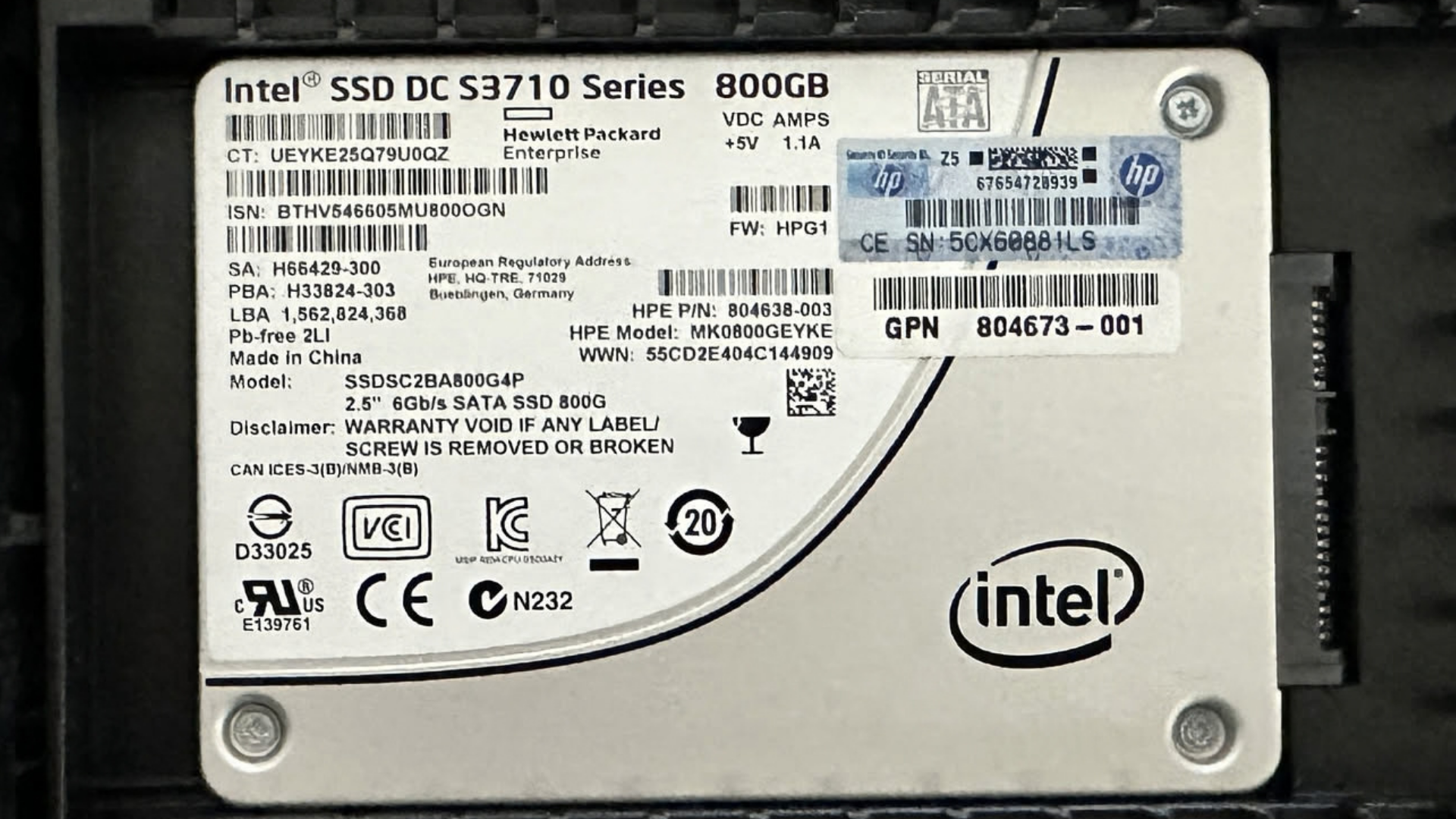
Intel SSD DC S3710 Series 800GB Enterprise SATA SSD
•
Form Factor: 2.5-inch SFF (100.00 × 69.85 × 7.00 mm) in HPE 3.5″ Smart Carrier
•
Interface & Protocol: SATA 6 Gbps (Revision 3.0) • AHCI / NCQ
•
Controller & Memory: Intel PC29AS21CB0 (“Haleyville”) • 1 GB DDR3-1600 • Intel 20nm HET MLC
•
Endurance Tier: Write-Intensive 10 DWPD • 16.9 PBW (16,900 TBW)
•
Museum Inventory: 1 Unit (Intel SSDSC2BA800G4P • HPE 804671-B21 • CT UEYKE25Q79U0QZ • S/N 5CX60881LS • FW HPG6)
1. Technical Overview & Key Specifications Table
| Category | Property | Specification |
|---|---|---|
| Drive Identity | Model Name | Intel® Solid-State Drive DC S3710 Series 800GB |
| Intel Generic Model Code | SSDSC2BA800G4 (OEM Base) • SSDSC2BA800G4P (Physical Nameplate SKU) |
|
| HPE OEM Model Name | MK0800GEYKE (HPE 800GB SATA WI SFF SC SSD) | |
| HPE Marketing Description | HPE 800GB 6G SATA Write Intensive-2 SFF 2.5-in SC 3yr Wty Solid State Drive | |
| HPE Part Numbers | Option P/N: 804671-B21 • Assembly P/N: 804638-003 • GPN: 804673-001 |
|
| Museum Unit Serialization | HPE CT: UEYKE25Q79U0QZ • CE SN: 5CX60881LS • ISN: BTHV546605MU800OGN |
|
| World Wide Name (WWN) | 55CD2E404C144909 (IEEE OUI: 55-CD-2E Intel Corporation) |
|
| Firmware Revisions | Factory Original: HPG1 • Upgraded Production: HPG6 (Aug 14, 2020) |
|
| Manufacturing Origin & Assembly | Made in China • SA: H66429-300 • PBA: H33824-303 • Pb-free 2LI |
|
| Form Factor & Carrier | Standard 2.5-inch SFF (7.00 mm z-height) mounted in HPE 3.5-inch LFF SmartDrive Carrier Tray | |
| Bus Interface & Protocol | SATA 6 Gbps (SATA Revision 3.0, 6/3/1.5 Gb/s) • AHCI / ATA8-ACS2 • NCQ (32 commands) | |
| Commercial Launch Window | January 2015 (High-endurance enterprise flagship replacing DC S3700) | |
| Controller & DRAM Silicon | Controller Model | Intel PC29AS21CB0 (Code Name: “Haleyville” • 3rd Gen Enterprise SATA Controller) |
| Controller Architecture & Channels | 8-Channel High-Performance Flash Controller • 32-bit RISC core architecture | |
| Controller Predecessor Comparison | Upgraded revision of PC29AS21CA0 (featured in S3700/S3500) optimized for 20nm HET MLC program timings |
|
| Error Correction Engine | Proprietary Intel Enterprise Multi-Stage ECC Engine with advanced parity and soft-decision decoding | |
| DRAM Cache Capacity | 1,024 MB (1 GB) dedicated enterprise volatile buffer | |
| DRAM Architecture & Packages | 2× 512 MB DDR3-1600 SDRAM packages (front and rear PCB topology) | |
| Address Mapping Architecture | 1:1 full-span logical-to-physical address translation table maintained in RAM with zero external host paging | |
| End-to-End Data Path Protection | Full internal CRC32, parity, and ECC covering all internal SRAM, controller buses, DRAM, and flash interfaces | |
| NAND Flash Memory | Flash Manufacturer & Lithography | Intel Corporation • 20 nm Planar High Endurance Technology (HET) |
| Cell Technology & Bits Per Cell | Multi-Level Cell (MLC) • 2 bits per cell (4 discrete threshold voltage distributions) | |
| High Endurance Technology (HET) | Silicon gate oxide tuning, tailored thermal diffusion profiles, and proprietary cycling algorithms yielding enterprise endurance | |
| Die Architecture | Dual-plane monolithic dies supporting concurrent interleaved plane operations per channel | |
| Flash Channel Interconnect | 8 Flash Channels operating synchronously with multiple Chip Enables (CE) per channel | |
| Raw Installed Flash Capacity | 1,024 GB (1 TB) physical flash across 16 BGA packages | |
| User Addressable Sectors (LBA) | 1,562,824,368 Sectors (800,166,076,416 Bytes • 800.17 GB formatted capacity) | |
| Factory Overprovisioning Reserve | 224 GB (~28% factory overprovisioning spare pool) for continuous background garbage collection | |
| Native Write Mechanics | Deterministic direct-to-MLC writing with zero SLC cache degradation or write cliffs | |
| Performance & IOPS | Sequential Read (128KB, QD32) | 550 MB/s (SATA 6 Gbps bus ceiling) |
| Sequential Write (128KB, QD32) | 460 MB/s (Steady-state full-span dirty drive) | |
| Random 4KB Read (QD32) | 85,000 IOPS | |
| Random 4KB Write (QD32) | 39,000 IOPS (Steady-state enterprise preconditioned) | |
| Random 4KB 70/30 Mixed IOPS | 62,000 IOPS (Typical virtualized server workload) | |
| Random 8KB Read / Write | 52,000 IOPS Read • 19,000 IOPS Write | |
| Average Latency (QD1) | Read: 55 μs (0.055 ms) • Write: 66 μs (0.066 ms) | |
| Quality of Service & Consistency | 99.9% QoS: 500 μs Read / 5 ms Write • 90% Performance Consistency | |
| Endurance & Reliability | Drive Writes Per Day (DWPD) | 10 DWPD (Guaranteed over 5 full years under 100% 4KB random writes) |
| Total Petabytes Written (PBW) | 16.9 PBW (16,900 TBW) • Equivalent to 8.0 Terabytes written per day for 5 years | |
| Mean Time Between Failures (MTBF) | 2.0 Million Operating Hours • Annualized Failure Rate (AFR): 0.44% | |
| Uncorrectable Bit Error Rate | < 1 sector per 1017 bits read (Enterprise datacenter benchmark) | |
| Power-On to Ready Time | 7.0 seconds (Clean shutdown) • Extended on capacitor power-loss recovery | |
| Enterprise Warranty Coverage | 5-Year Intel Enterprise Limited Warranty / 3-Year HPE Server Warranty | |
| Electrical & Physical | Operating Voltage & Rails | 5V DC (±5%) or 5V + 12V DC dual supply support • Nameplate Rating: +5V @ 1.1A |
| Active Write Power Draw | 5.9 W RMS Average (with PLP cap charging) • 8.8 W Burst • 11.1 W Max Burst | |
| Active Read & Idle Power | 3.0 W RMS Average Read • 600 mW (0.6 W) Idle | |
| Operating Temperature Envelope | 0°C to 70°C • Non-operating: -55°C to 95°C • Integrated thermal throttling telemetry | |
| Dimensions & Bare Weight | 100.0 mm (L) × 69.85 mm (W) × 7.00 mm (H) • Net Weight: 88 g (±2 g) | |
| Enclosure & Carrier Construction | Cast aluminum case with internal thermal pad heatsinking • HPE SmartDrive 3.5″ caddy with ejector handle | |
| Enterprise Protection & Compliance | Hardware Power Loss Protection | Enhanced Power-Loss Data Protection (PLI) backed by discrete electrolytic hold-up capacitors |
| Cryptographic Security | AES 256-bit hardware encryption engine • Sanitization via ATA Enhanced Secure Erase | |
| Capacitor Health Self-Test Telemetry | SMART Attribute AFh actively logs capacitor discharge time in μs, test intervals, and lifetime runs |
|
| Data Path Integrity Engine | End-to-end CRC check and LBA tagging from host interface through internal bus to NAND cells | |
| Regulatory Agency Certifications | UL (cURus E139761) • CE • TÜV • FCC Class B • VCCI • KC • BSMI (D33025) • RCM (N232) • China RoHS (EFUP 20) • WEEE |
2. Controller Silicon, FTL Architecture & Deterministic Write Mechanics
At the silicon core of the Intel SSD DC S3710 lies the proprietary Intel PC29AS21CB0 “Haleyville” storage processor. Evolving directly from the legendary PC29AS21CA0 controller that powered the pioneer DC S3700 series, the CB0 stepping was re-architected with upgraded internal microcode execution engines specifically tuned for Intel’s second-generation 20nm High Endurance Technology (HET) MLC NAND flash.
Dedicated 1 GB DDR3 FTL Buffer
The DC S3710 pairs the PC29AS21CB0 processor with 1,024 MB (1 GB) of high-speed DDR3-1600 SDRAM split across dual surface-mount packages. This memory pool houses the entire 1:1 logical-to-physical address translation (FTL) table in volatile SRAM/DRAM. Because the entire metadata structure remains permanently memory-resident, command lookup latencies are capped at an ultra-low 55 μs, completely avoiding secondary metadata flash reads.
Zero-SLC-Cache Deterministic Writing
Unlike consumer SSDs that mask slow flash program speeds using dynamic pseudo-SLC cache buffers that inevitably collapse into catastrophic write cliffs, the DC S3710 operates with strict deterministic write pipelines. Data streams directly into 20nm HET MLC NAND flash at a sustained 460 MB/s sequential and 39,000 IOPS random write rate, guaranteeing 90% performance consistency indefinitely.
The Intel PC29AS21CB0 controller coordinates 8 independent, synchronous flash channels. In this 800GB capacity, 16 multi-die MLC packages provide multiple interleaved Chip Enables (CE) per channel. This massive internal parallelism yields over 2.0 GB/s of raw internal flash bandwidth, allowing the controller to execute continuous background block reclamation, wear leveling, and capacitor self-tests without inducing command queue latency spikes on the 600 MB/s SATA III interface.
3. Monospace ASCII Silicon Architecture & Storage Topology Map
A comprehensive hardware schematic illustrating the internal interconnect topology between host interface, Intel PC29AS21CB0 controller, DDR3 cache, hardware power-loss protection capacitor bank, and the 8-channel flash array:
+----------------------------------------------------------------------------------------------------+
|                       INTEL SSD DC S3710 SERIES 800GB ENTERPRISE SATA ARCHITECTURE                 |
+----------------------------------------------------------------------------------------------------+
                                                  |
                         [SATA 6 Gbps Interface: 7-Pin Data + 15-Pin Power (5V / 12V)]
                                                  |
                +---------------------------------v----------------------------------+
                |                                                                    |
                |               INTEL PC29AS21CB0 CONTROLLER SILICON ("HALEYVILLE")  |
                |              (Enterprise 3rd Gen SATA ASIC • 8-Channel Architecture) |
                |                                                                    |
                |  +---------------------------+       +--------------------------+  |
                |  | Protocol Front-End Engine |       | Back-End Flash Engine    |  |
                |  | SATA 6 Gbps Link & NCQ 32 |       | Wear-Leveling & GC Alloc |  |
                |  | End-to-End CRC32 Checker  |       | 1:1 FTL Mapping Manager  |  |
                |  +-------------+-------------+       +-------------+------------+  |
                |                |                                   |               |
                |  +-------------v-----------------------------------v------------+  |
                |  |      Intel Enterprise Multi-Stage ECC & Parity Protection    |  |
                |  |            (Iterative Soft-Decision & Defect Repair)         |  |
                |  +-----------------------------+--------------------------------+  |
                |                                |                                   |
                |  +-----------------------------v--------------------------------+  |
                |  |  8-Channel Synchronous Flash Interface (32 Total CE Targets) |  |
                |  +--------------------------------------------------------------+  |
                +----------------------+---------------------------+-----------------+
                                       |                           |
        +------------------------------v---+           +-----------v---------------------+
        |    DEDICATED DRAM CACHE BUFFER   |           | HARDWARE POWER LOSS PROTECTION  |
        |  1,024 MB (1 GB) DDR3-1600 SDRAM |           | Discrete Electrolytic Capacitor |
        |  Dual 512 MB Surface-Mount Chips |           | Hold-Up Array • Telemetry AFh   |
        +----------------------------------+           +---------------------------------+
                                       |
          +----------------------------+----------------------------+
          |                            |                            |
+---------v--------+          +--------v---------+         +--------v---------+         +--------v---------+
| FLASH CHANNELS   |          | FLASH CHANNELS   |         | FLASH CHANNELS   |         | FLASH CHANNELS   |
| Channels 0 & 1   |          | Channels 2 & 3   |         | Channels 4 & 5   |         | Channels 6 & 7   |
| (8 CE Targets)   |          | (8 CE Targets)   |         | (8 CE Targets)   |         | (8 CE Targets)   |
+---------+--------+          +--------+---------+         +--------+---------+         +--------+---------+
          |                            |                            |                            |
+---------v------------------++--------v------------------++--------v------------------++--------v---------+
| PACKAGES 0 - 3             || PACKAGES 4 - 7            || PACKAGES 8 - 11           || PACKAGES 12 - 15         |
| Intel 20nm HET MLC NAND    || Intel 20nm HET MLC NAND   || Intel 20nm HET MLC NAND   || Intel 20nm HET MLC NAND  |
| 4× BGA Packages (PCB Top)  || 4× BGA Packages (PCB Top) || 4× BGA Packages (Bottom) || 4× BGA Packages (Bottom)|
| Dual-Plane Monolithic Dies || Dual-Plane Monolithic Dies|| Dual-Plane Monolithic Dies|| Dual-Plane Monolithic Die|
+----------------------------++---------------------------++----------------------------++-------------------------+
| TOTAL RAW FLASH: 1,024 GB (16 Packages × 64 GB raw • 32 Concurrent Flash Planes)                            |
| USER CAPACITY: 800 GB (1,562,824,368 LBA Sectors) • FACTORY OVERPROVISIONING SPARE: 224 GB (~28% Pool)         |
+------------------------------------------------------------------------------------------------------------------+
4. High Endurance Technology (HET), 20nm MLC Physics & 10 DWPD Longevity
The defining attribute of the Intel SSD DC S3710 series is its uncompromising endurance rating: 10 full Drive Writes Per Day (DWPD) for 5 consecutive years. On this 800GB drive, this equates to 16.9 Petabytes Written (16,900 TBW), or approximately 8.0 Terabytes written every single day of its operating life.
While standard consumer Multi-Level Cell (MLC) flash guarantees approximately 3,000 program/erase (P/E) cycles before dielectric breakdown, Intel’s High Endurance Technology achieves an astonishing over 50,000 P/E cycles on planar 20nm silicon. Intel achieved this breakthrough through three interrelated engineering vectors:
- Silicon Doping & Oxide Purity: Thickened, defect-free tunnel oxide layers engineered to withstand high electron tunneling potentials without developing parasitic traps.
- Precision Cell Cycling Algorithms: Pulse-shaping program voltages that incrementally nudge electrons into the floating gate, avoiding structural oxide stress.
- Massive 28% Factory Overprovisioning: 224 GB of spare flash enables the controller to absorb random 4KB writes across fresh, unfragmented physical blocks, reducing the Write Amplification Factor (WAF) to near unity.
| Drive Model & NAND Architecture | Endurance Rating (DWPD) | Lifetime 5-Year TBW | Target Datacenter Duty |
|---|---|---|---|
| Intel SSD DC S3710 800GB (20nm HET MLC) | 10.0 DWPD | 16,900 TBW (16.9 PBW) | Write Intensive (ZFS SLOG, OLTP DB, Logging) |
| Intel SSD DC S3610 800GB (20nm Standard MLC) | 3.0 DWPD | 5,300 TBW (5.3 PBW) | Mixed Use (Virtualization, Web, File) |
| Intel SSD DC S3510 800GB (16nm Standard MLC) | 0.3 DWPD | 460 TBW | Read Intensive (Boot, Web Hosting) |
| Micron 5210 ION 1.9 TB (64L 3D QLC) | 0.2 – 0.8 DWPD | 280 – 2,803 TBW | Read-Centric Archival / Media Streaming |
| Consumer SATA SSD 1 TB (TLC / QLC) | 0.1 – 0.3 DWPD | 300 – 600 TBW | Client Desktop / Laptop (No PLP Protection) |
5. Enterprise Power-Loss Protection (PLP) & Advanced SMART Telemetry
A primary vulnerability of enterprise storage arrays is unexpected host power severance while uncommitted write buffers reside in volatile memory. Intel’s Enhanced Power-Loss Data Protection (PLI) integrates discrete hold-up capacitors directly onto the PCB, providing sufficient auxiliary energy to safely write all in-flight data and commit the DRAM FTL journal into non-volatile MLC NAND flash.
| ID | SMART Attribute Name | Threshold | Enterprise Functional Role & Measurement |
|---|---|---|---|
05h |
Re-allocated Sector Count | 0 (None) | Reports cumulative retired physical flash blocks since leaving the factory. |
09h |
Power-On Hours Count | 0 (None) | Cumulative operational hours across the entire lifespan of the SSD. |
0Ch |
Power Cycle Count | 0 (None) | Total complete power cycle events recorded by the controller. |
AAh |
Available Reserved Space | 10% | Normalized available pool of overprovisioned factory reserve blocks (starts at 100). |
AEh |
Unexpected Power Loss Count | 0 (None) | Unclean host shutdowns occurring without prior STANDBY IMMEDIATE command. |
AFh |
Power Loss Protection Failure | 10% | Capacitor Discharge Health Telemetry: Bytes 0-1 log capacitor discharge time in μs (valid: 25 to 5,000,000 μs); Bytes 2-3 log minutes since last test; Bytes 4-5 record lifetime test count. |
B8h |
End-to-End Error Detection Count | 90 | Detects and reports LBA tag mismatches across internal data pathways. |
BBh |
Uncorrectable Error Count | 0 (None) | Flash read errors that exceeded the ECC engine’s recovery capacity. |
C2h |
Device Internal Temperature | 0 (None) | Direct PCB temperature telemetry reported by on-die thermal sensors. |
E1h |
Total Host Writes | 0 (None) | Raw counter increments by 1 for every 65,536 sectors (32 MB) written by host. |
E9h |
Media Wearout Indicator | 0 (None) | Normalized value declines linearly from 100 to 1 as average erase cycle count approaches maximum rated endurance. |
EAh |
Thermal Throttle Status | 0 (None) | Byte 0 reports throttling percentage (0 = No Throttle, 100 = 100% throttling); Bytes 1-4 report total lifetime throttle events. |
6. Authentic Hardware Photography & Physical Silicon Inspection
High-resolution physical optical inspection of the museum’s Intel SSD DC S3710 800GB unit mounted in its authentic Hewlett Packard Enterprise (HPE) 3.5-inch SmartDrive carrier converter tray:
Exhibit 6.1: Physical Drive in HPE Smart Carrier LFF Converter Frame
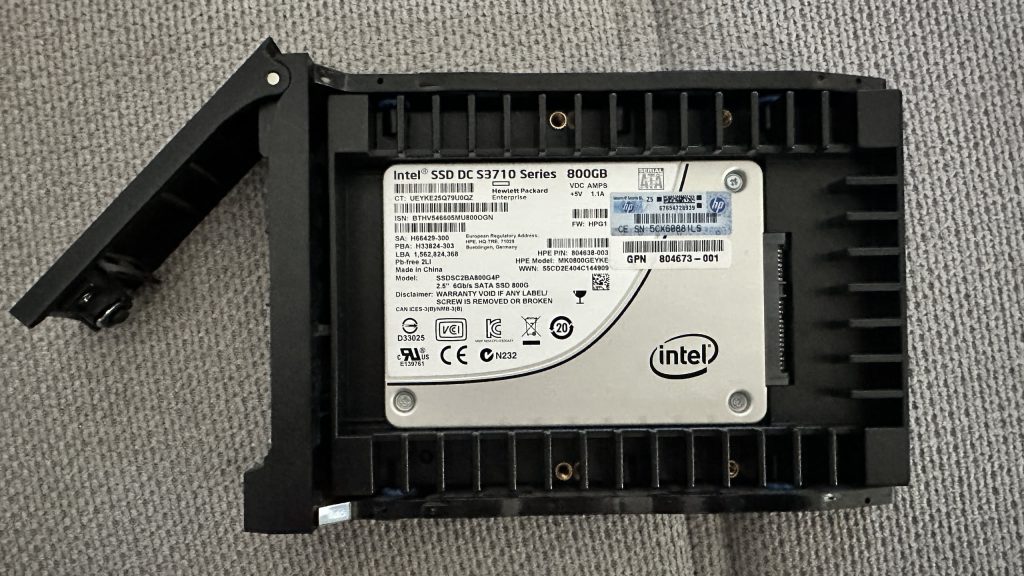
Museum Hardware Artifact: Authentic Intel SSD DC S3710 800GB enterprise solid-state drive (Model: SSDSC2BA800G4P, HPE Model: MK0800GEYKE, Option P/N: 804671-B21) mounted in an HPE 3.5″ SmartDrive converter frame featuring hot-swap ejection handle, thermal ventilation fins, and blue vibration-damping grommets.
Production Nameplate Data Decoded
Intel SSD DC S3710 Series 800GB: Primary Intel enterprise model designation.Model: SSDSC2BA800G4P: Intel ordering code for 800GB 2.5″ 7mm form factor.HPE Model: MK0800GEYKE: HPE enterprise firmware SKU for Write Intensive (WI) duty.CT: UEYKE25Q79U0QZ: HPE Component Tracking identifier.CE SN: 5CX60881LS: Holographic authenticity tracking serial number.ISN: BTHV546605MU800OGN: Internal factory barcode tracking identifier.SA: H66429-300 • PBA: H33824-303: Intel factory stock and printed board assembly revisions.WWN: 55CD2E404C144909: IEEE registered unique 64-bit storage identifier.
Carrier Mechanics & Electrical Conformity
- Electrical Nameplate:
+5V 1.1Aindicates nominal active power draw of 5.5 W, aligning precisely with Intel Table 8 measurements. - HPE Smart Carrier Tray: Part
804673-001converts the 2.5″ drive to standard 3.5″ LFF bays, providing quick-eject latches and LED light guides for drive activity/fault state. - Acoustic & Vibration Dampening: Integrated blue silicone isolation bushings decouple server chassis vibration from the SSD’s delicate internal soldered BGA matrix.
- Thermal Ventilation: Cast aluminum heatsink side fins facilitate passive airflow channeling across the drive chassis inside dense server backplanes.
7. Curator’s Assessment & Homelab Applicability
The Intel SSD DC S3710 represents the pinnacle of SATA enterprise solid-state engineering. Built during an era when planar NAND endurance was prioritized above absolute die stacking density, the S3710 occupies an elite tier that modern QLC and TLC drives simply cannot match:
- The Ultimate ZFS SLOG (Separate Intent Log) Device: In TrueNAS, Proxmox VE, and enterprise ZFS deployments, synchronous write performance depends entirely on the write-log device. Consumer drives without full power-loss protection (PLP) or with pseudo-SLC caching induce high latency spikes under synchronous ZFS writes. The S3710 combines full hardware PLP, sub-70 μs write latency, and 16.9 PBW endurance, making it the definitive SATA SLOG accelerator for mission-critical pools.
- Unbreakable Virtual Machine Root & Database Storage: Heavy random write workloads, such as transactional databases (PostgreSQL, MySQL, MariaDB), Redis caching instances, and time-series telemetry loggers (InfluxDB, Prometheus), rapidly exhaust the write cycles of client SSDs. The S3710 absorbs 10 full drive writes per day without breaking a sweat, providing continuous, deterministic 39,000 IOPS write throughput.
- Enterprise Peace of Mind via Hardware PLP: Sudden power interruptions that corrupt unbuffered FTL tables in consumer drives are seamlessly handled by the S3710’s hold-up capacitor bank. In-flight write buffers and DRAM FTL journals are safely committed to 20nm HET MLC NAND every single time.
- Museum Hardware Provenance: Mateo’s Museum preserves 1 physical unit of the Intel SSD DC S3710 Series 800GB (Intel Model:
SSDSC2BA800G4P, HPE Model:MK0800GEYKE, HPE Option P/N:804671-B21, Assembly P/N:804638-003, GPN:804673-001, HPE Component Tracking CT:UEYKE25Q79U0QZ, Holographic Serial:5CX60881LS, Internal Serial:BTHV546605MU800OGN, WWN:55CD2E404C144909). The drive was originally provisioned with factory firmwareHPG1and subsequently upgraded to HPE production releaseHPG6(August 14, 2020), securing updated PLP discharge diagnostics and thermal management routines. Mounted in its authentic 3.5″ SmartDrive carrier frame, this unit represents a masterclass in datacenter silicon reliability.