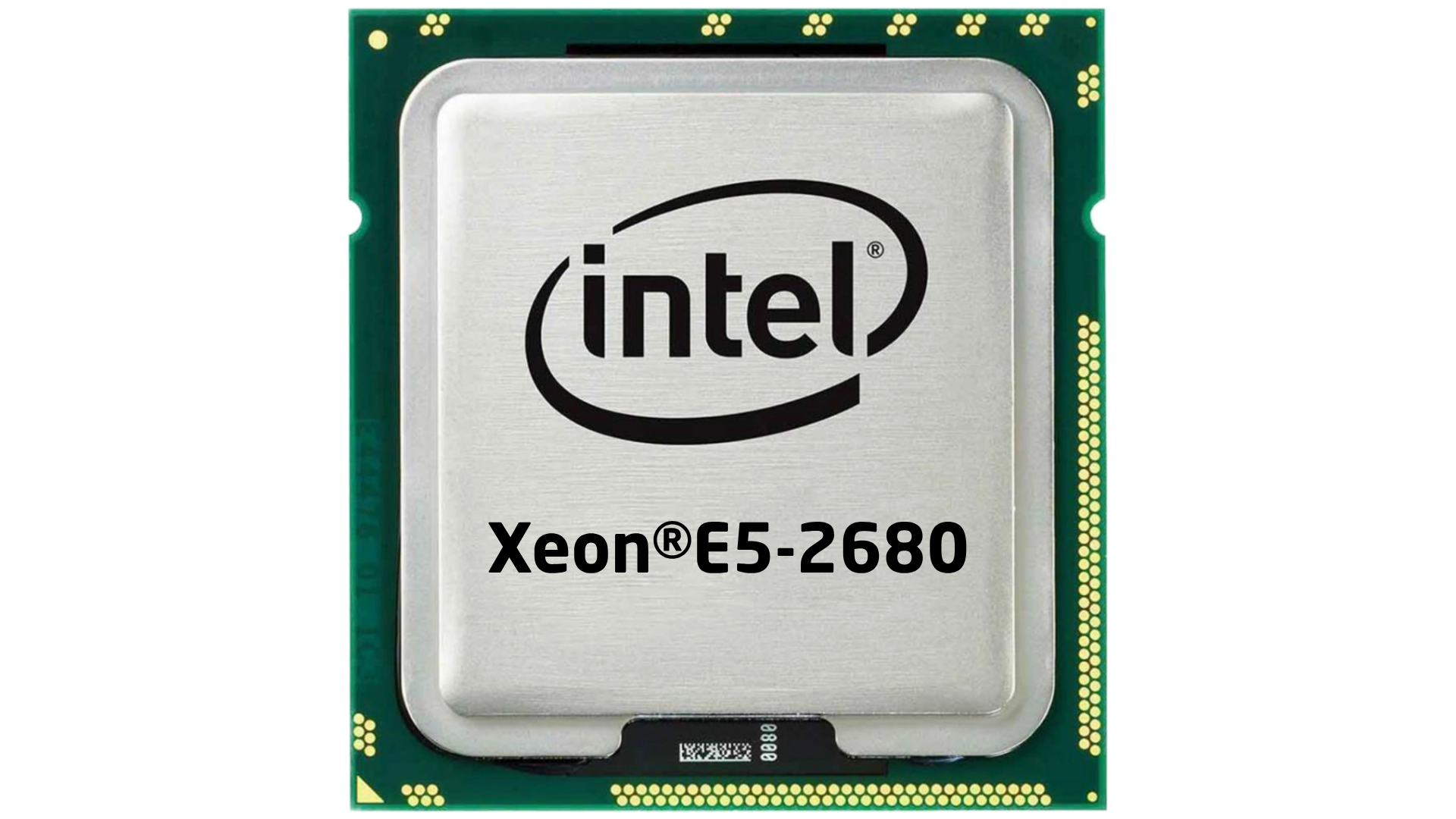
Intel Xeon E5-2680 Processor
•
Microarchitecture: Sandy Bridge-EP (32 nm)
•
Socket: Socket R (LGA 2011 / FC-LGA10)
•
Museum Inventory: 4 Units (Verified SR0KH / C2 Stepping; 1 Active in Corsair Air 540 “Cube”, 3 Archive)
•
Source Authority: TechPowerUp, Intel Ark & PassMark
1. Technical Overview & Key Specifications
| Category | Property | Specification |
|---|---|---|
| Processor Identity | Model Name | Intel® Xeon® Processor E5-2680 (SKU: 64583 • PassMark ID: 1221) |
| Microarchitecture | Sandy Bridge-EP (Xeon E5 Family) | |
| Market Segment | Server / Workstation (Up to 2-socket SMP configuration) | |
| Launch Date | March 6, 2012 (Q1’12 launch • PassMark charts Q2’12) | |
| Part Numbers / S-Spec | SR0KH (C2 stepping • Verified Museum Inventory: 4 units: 1 actively deployed in Corsair Air 540 “Cube” workstation, 3 preserved archive units), SR0GY (C1 stepping) |
|
| Physical & Manufacturing | CPU Socket | Socket R (LGA 2011, FC-LGA10 package, 2011-pin) |
| Manufacturing Process | 32 nm High-k Metal Gate (Intel Foundry) | |
| Transistor Count | 2.27 Billion transistors | |
| Die Surface Area | 435 mm² | |
| Cores & Performance | Physical Cores / Threads | 8 Cores / 16 Threads (Intel Hyper-Threading Technology) |
| Base Clock Frequency | 2.70 GHz (2700 MHz) | |
| Max Turbo Frequency | Up to 3.50 GHz (Intel Turbo Boost Technology 2.0) | |
| Base Clock / Multiplier | 100 MHz BCLK / 27.0× (Multiplier Locked) | |
| Bus Interconnect | Dual Intel® QuickPath Interconnect (QPI) links at 8.00 GT/s | |
| Multi-CPU Scalability | Up to 2 Processors (2S symmetric multiprocessing) | |
| Thermal & Electrical | Thermal Design Power (TDP) | 130 W |
| Nominal Operating Voltage | 1.35 V | |
| Cache Hierarchy | Level 1 (L1) Cache | 64 KB per core (32 KB Data + 32 KB Instruction) • 512 KB Total |
| Level 2 (L2) Cache | 256 KB dedicated per core • 2048 KB (2 MB) Total | |
| Level 3 (L3) Cache | 20 MB Intel® Smart Cache (shared ring pool across all 8 cores) | |
| Memory Controller | Memory Topology | Quad-Channel DDR3 memory interface (4 discrete channels) |
| Supported Memory Types | DDR3-800 / 1066 / 1333 / 1600 MHz | |
| Max Capacity / ECC | Up to 384 GB (PassMark specification); ECC supported | |
| Module Compatibility | Registered DIMMs (RDIMM), Load-Reduced DIMMs (LRDIMM), Unbuffered (UDIMM) | |
| PassMark Benchmarks | Average CPU Mark (Multithread) | 9,284 (Median: 9,435 across 294 low-margin samples) |
| Single Thread Rating | 1,564 MOps/Sec | |
| Server CPU Category Rank | Rank #736 out of 1,261 Server CPUs in PassMark database | |
| Expansion & Graphics | PCI Express Interface | PCI-Express Revision 3.0 (Gen 3) direct CPU root complex |
| Integrated Graphics Engine | None (N/A • requires discrete GPU or server motherboard onboard BMC video) |
2. Silicon Topology & Sandy Bridge-EP Microarchitecture
Compute Die Scale
2.27B
Transistors across 435 mm² die surface
Physical Execution Engines
8 Cores / 16 Threads
2.70 GHz base clock with 3.50 GHz turbo boost
Shared Last Level Cache
20 MB
Intel Smart Cache on bi-directional ring bus
Internal Silicon Die Topology & Ring Interconnect
+---------------------------------------------------------------------------------------+
|                    INTEL XEON E5-2680 SILICON TOPOLOGY (SANDY BRIDGE-EP)              |
|                                                                                       |
|   +-------------+  +-------------+  +-------------+  +-------------+                  |
|   |   CORE 0    |  |   CORE 1    |  |   CORE 2    |  |   CORE 3    |                  |
|   | 32K+32K L1  |  | 32K+32K L1  |  | 32K+32K L1  |  | 32K+32K L1  |                  |
|   |   256K L2   |  |   256K L2   |  |   256K L2   |  |   256K L2   |                  |
|   +------+------+  +------+------+  +------+------+  +------+------+                  |
|          |                |                |                |                         |
|   === ring stop ======== ring stop ====== ring stop ====== ring stop ==============+  |
|   ||     |                |                |                |                     ||  |
|   ||  2.5MB L3         2.5MB L3         2.5MB L3         2.5MB L3                 ||  |
|   ||                                                                              ||  |
|   ||          BI-DIRECTIONAL RING INTERCONNECT (HIGH-BANDWIDTH BUS)               ||  |
|   ||                                                                              ||  |
|   ||  2.5MB L3         2.5MB L3         2.5MB L3         2.5MB L3                 ||  |
|   ||     |                |                |                |                     ||  |
|   === ring stop ======== ring stop ====== ring stop ====== ring stop ==============+  |
|          |                |                |                |                         |
|   +------+------+  +------+------+  +------+------+  +------+------+                  |
|   |   CORE 4    |  |   CORE 5    |  |   CORE 6    |  |   CORE 7    |                  |
|   | 32K+32K L1  |  | 32K+32K L1  |  | 32K+32K L1  |  | 32K+32K L1  |                  |
|   |   256K L2   |  |   256K L2   |  |   256K L2   |  |   256K L2   |                  |
|   +-------------+  +-------------+  +-------------+  +-------------+                  |
|                                                                                       |
|   [ INTEGRATED MEMORY CONTROLLER ]           [ I/O & INTERCONNECT CONTROLLER ]        |
|    - 4 x DDR3 Channels (Quad-Channel)         - Direct PCI Express 3.0 Root Complex   |
|    - ECC Registered / Unbuffered              - Dual QPI Links (8.00 GT/s each to 2S) |
+---------------------------------------------------------------------------------------+
3. Quad-Channel Memory & QuickPath Interconnect (QPI)
Integrated Quad-Channel DDR3
- Memory Channels: 4 discrete 64-bit channels integrated directly into processor silicon.
- Speeds Supported: DDR3-800, DDR3-1066, DDR3-1333, and DDR3-1600 MHz.
- Enterprise Reliability: Full hardware support for ECC (Error-Correcting Code) Registered RDIMMs and LRDIMMs.
- Massive Memory Bandwidth: High memory throughput essential for multi-tenant hypervisor workloads.
Dual 8.00 GT/s QPI Links
- Interconnect Type: Intel® QuickPath Interconnect (QPI) point-to-point packetized bus.
- Bus Transfer Rate: 8.00 GT/s (Gigatransfers per second) per link direction.
- Dual Socket Coherency: Dual QPI links enable ultra-fast cache-coherent communication with a secondary CPU in 2S configurations.
- Scalability: Designed for seamless SMP operation across dual-socket enterprise motherboards.
4. Advanced Technologies, Virtualization & Security
| Technology Category | Feature / Instruction Set | Functional Capability |
|---|---|---|
| Hardware Virtualization | Intel® VT-x | Hardware virtualization assistance with Extended Page Tables (EPT) for low hypervisor overhead |
| Intel® VT-d | Virtualization for Directed I/O (PCI device passthrough to guest VMs in Proxmox / ESXi) | |
| Hyper-Threading (HTT) | Enables 16 logical execution contexts from 8 physical processing cores | |
| Vector & Crypto Acceleration | Intel® AVX | Advanced Vector Extensions: 256-bit SIMD integer and floating-point acceleration |
| Intel® AES-NI | Hardware-accelerated AES encryption and decryption for wire-speed VPNs and storage arrays | |
| SSE4.1 / SSE4.2 | Streaming SIMD Extensions 4.1/4.2 plus SSSE3, SSE3, SSE2, SSE, and MMX instructions | |
| Platform Security & Power | Intel® TXT & XD bit | Trusted Execution Technology and Execute Disable Bit memory buffer protection against malware |
| Intel® Turbo Boost 2.0 | Dynamic frequency scaling boosting core speeds from 2.70 GHz base up to 3.50 GHz under load | |
| Enhanced SpeedStep (EIST) | Intelligent voltage and frequency throttling to reduce idle server power draw |
5. PassMark Benchmark Dossier & Synthetic Performance (PerformanceTest V10)
Multithread Rating (CPU Mark)
9,284
Median: 9,435 across 294 samples (Low margin for error)
Single Thread Rating
1,564
Single-core execution throughput (MOps/Sec)
Data Encryption (AES-NI)
2,902
MBytes/Sec sustained hardware cryptographic rate
PassMark PerformanceTest V10 Detailed Test Suite Results
| Test Suite Routine | Average Result Metric | Operational Context |
|---|---|---|
| Integer Math | 37,512 MOps/Sec | General core processing & kernel execution |
| Floating Point Math | 13,884 MOps/Sec | Mathematical modeling and scientific simulation |
| Find Prime Numbers | 47 Million Primes/Sec | Pure CPU computational pipeline throughput |
| Random String Sorting | 23,795 Thousand Strings/Sec | Memory controller and cache indexing efficiency |
| Data Encryption | 2,902 MBytes/Sec | Hardware AES-NI encrypted storage & IPsec/WireGuard VPNs |
| Data Compression | 162,862 KBytes/Sec | ZFS LZ4 compression and backup archival pipelines |
| Physics Simulation | 688 Frames/Sec | Real-time physics calculation across parallel threads |
| Extended Instructions | 7,202 Million Matrices/Sec | Intel AVX 256-bit vectorized matrix transformations |
| Single Thread Performance | 1,564 MOps/Sec | Single-threaded latency and serial task responsiveness |
PassMark Relative Hierarchy: Sandy Bridge-EP Stack
| Processor Model | Cores / Frequency | Average CPU Mark | Relative Variance |
|---|---|---|---|
| Intel Xeon E5-2687W | 8C / 16T @ 3.10 GHz | 10,028 | +8.0% |
| Intel Xeon E5-2690 | 8C / 16T @ 2.90 GHz | 9,713 | +4.6% |
| Intel Xeon E5-2680 (Exhibit #2963) | 8C / 16T @ 2.70 GHz | 9,284 | Baseline (0.0%) |
| Intel Xeon E5-2670 | 8C / 16T @ 2.60 GHz | 8,875 | -4.4% |
| Intel Xeon E5-2665 | 8C / 16T @ 2.40 GHz | 8,287 | -10.7% |
| Intel Xeon E5-2660 | 8C / 16T @ 2.20 GHz | 7,982 | -14.0% |
| Intel Xeon E5-2650 | 8C / 16T @ 2.00 GHz | 7,416 | -20.1% |
6. Platform Synergy: Pairing with Supermicro X9SRi-F (Exhibit #2957) & Corsair Air 540 Workstation Deployment
Seamless Architectural Integration
The Intel Xeon E5-2680 processor is the ideal high-performance silicon match for the Supermicro X9SRi-F server motherboard cataloged in Exhibit #2957. Built on Intel’s Romley platform, the hardware subsystems integrate with zero architectural bottlenecks:
| Hardware Interface | Intel Xeon E5-2680 (Exhibit #2963) | Supermicro X9SRi-F (Exhibit #2957) |
|---|---|---|
| CPU Socket | Socket R (LGA 2011, 2011-pin) | Single Socket R with 6-phase VRM rated up to 135W TDP |
| Memory Bus | Quad-Channel DDR3 memory controller | 8 DIMM slots arranged in 4 channels (up to 256 GB RDIMM) |
| PCI Express Bandwidth | PCIe 3.0 (8.0 GT/s) direct root ports | Drives primary Slot 6 (x16) and Slot 4 (x8 in x16) natively |
| Display Output | No integrated graphics silicon (headless) | Onboard Matrox G200eW via Nuvoton BMC for local console |
Active Workstation Deployment: Corsair Carbide Series Air 540 “Cube”
Unit #1 of the museum collection is actively deployed as the central compute engine in Marius’ custom homelab workstation housed within the Corsair Carbide Series Air 540 High Airflow ATX Cube Case (Exhibit #2949). Installed on the Supermicro X9SRi-F (Exhibit #2957) server motherboard (PCB Rev 1.20, Serial: ZM14BS021242, AMI BIOS 3.3, IPMI BMC 3.64), the processor operates alongside an aggregate 160 GB Registered ECC DDR3 memory array and an MSI GeForce RTX 3050 LP 6G OC discrete graphics card.
Verified Live Hardware Telemetry & Diagnostics (Host: cube • 192.168.111.71)
| Diagnostic Parameter | Empirical Live Value | Field Validation Notes |
|---|---|---|
| Operating System & Kernel | Ubuntu 22.04.5 LTS (x86_64) | Linux Kernel 5.15.0-194-generic |
| Hardware Stepping & S-Spec | SR0KH • C2 Stepping (Family 6, Model 45, Stepping 7) |
Silicon stepping verified via /proc/cpuinfo and DMI Type 4 |
| Microcode Revision | 0x71a |
Latest production microcode mitigation loaded |
| Compute Throughput (Sysbench) | 4,320.92 events/sec | Sysbench 1.0.20 prime computation (16 concurrent execution threads, 3.70 ms avg latency) |
| Thermal Telemetry (Idle) | +32.0°C (Core temps: 25.0°C to 32.0°C) | Ambient direct chamber airflow in Corsair Air 540 |
| Thermal Telemetry (Load) | +34.0°C to +35.0°C | Under sustained 16-thread prime number computation load |
| IPMI Sensor Voltages | Vcore: 0.78 V • CPU VTT: 1.06 V | Monitored via onboard Nuvoton WPCM450 BMC (ipmitool 1.8.18) |
| Memory Array Environment | 160.0 GB Total RAM (157 GiB usable) | Quad-channel DDR3 across 8 slots; EDAC reports 0 correctable and 0 uncorrectable errors |
7. Curator’s Assessment & Homelab Applicability
- Museum Hardware Provenance: Mateo’s Museum collection holds 4 verified physical units of the Intel Xeon E5-2680 processor. All four units feature production S-Spec SR0KH (C2 stepping), which incorporates critical hardware errata fixes and enhanced VT-d virtualization stability compared to earlier stepping revisions. One unit is actively deployed as the central processing unit in the Corsair Carbide Air 540 “Cube” workstation, while the remaining three units are preserved in anti-static museum storage.
- Enterprise Virtualization Value: Delivering an Average CPU Mark of 9,284 with 8 physical cores and 16 hardware execution threads at 2.70 GHz base / 3.50 GHz turbo, the Xeon E5-2680 remains a formidable compute foundation for homelab hypervisors running Proxmox VE, TrueNAS, or container clusters.
- Exceptional Cryptographic Throughput: Hardware AES-NI instructions achieve 2,902 MB/s in PassMark encryption benchmarks, ensuring wire-speed IPsec and WireGuard VPN processing alongside full line-rate encrypted ZFS pool operations.
- Quad-Channel Memory Bandwidth: Paired with registered DDR3 ECC memory, the processor provides four memory channels that eliminate memory bandwidth bottlenecks during concurrent multi-tenant virtual machine execution.
- Robust I/O Virtualization (VT-d): Native support for Intel VT-d and PCIe 3.0 allows seamless PCI device passthrough, enabling direct assignment of SAS HBAs, 10GbE networking NICs, or compute accelerators directly into guest VMs.
- Sweet Spot of the Generation: Within 4.6% of the top 135W Xeon E5-2690 (9,713) and beating the widely deployed E5-2670 (8,875) and E5-2660 (7,982), the E5-2680 represents the premier balance of multi-core throughput, clock frequency, and thermal efficiency for Socket 2011.
- Empirical Production Validation: In live diagnostics on the Supermicro X9SRi-F within the Corsair Air 540 cube chassis, the actively deployed E5-2680 demonstrated extraordinary thermal and compute stability under Ubuntu 22.04 LTS. With microcode
0x71a, it delivered 4,320.92 events/sec in 16-thread sysbench compute tests while maintaining a cool package temperature of +32.0°C idle and peaking at only +34.0°C to +35.0°C under full load, orchestrating 160 GB of quad-channel ECC RAM with zero EDAC errors.