Bitmain Antminer D3 19.3G
Key Hardware Specifications
- Launch Date: 2017 (Batch / Date Code: Week 45, 2017 –
1745) - Manufacturer: Bitmain Technologies Ltd.
- Algorithm: X11 (Proof of Work for Dash)
- Hashrate: 19.3 GH/s (±5% at stock 537 MHz)
- Power Consumption: ~1,350 W (±10% at wall @ 25°C with APW3++ PSU)
- Power Efficiency: ~0.070 J/MH at stock; up to 0.045 J/MH with undervolt firmware
- Hash Boards: 3 ×
D3_DashBoard_V2.2- ASIC Chip: Bitmain
BM1760 - 60 × BM1760 X11 ASICs per board = 180 ASIC chips total
- Chain 0 → 60 ASICs
- Chain 1 → 60 ASICs
- Chain 2 → 60 ASICs (180 working BM1760 chips total)
- Board Telemetry MCU: Microchip
PIC16F1704(14-pin SOIC flash MCU per hashboard) - Power Stage: 3 × 6-pin PCIe female power connectors per board, 1.5 μH shielded power inductor, 5 × 1000 μF 16V solid polymer capacitors, 4 × power MOSFETs
- ASIC Chip: Bitmain
- Controller Architecture (Modular 2-Board Sandwich):
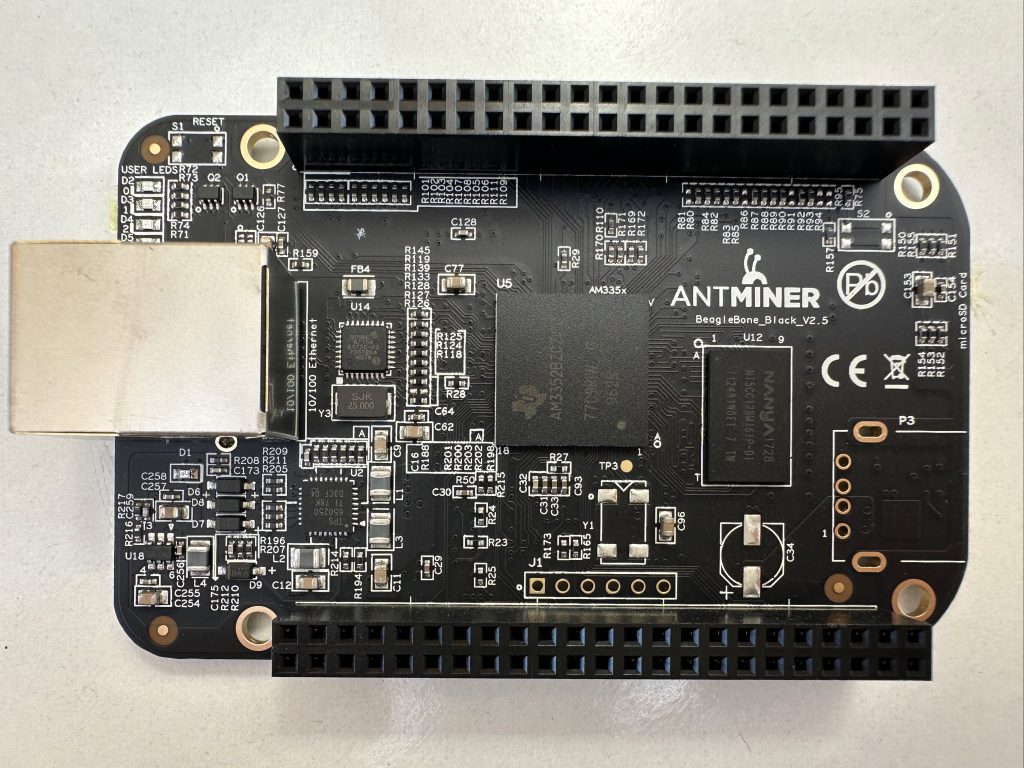
- Processing Module:
BeagleBone_Black_V2.5clone- CPU / SoC: Texas Instruments Sitara
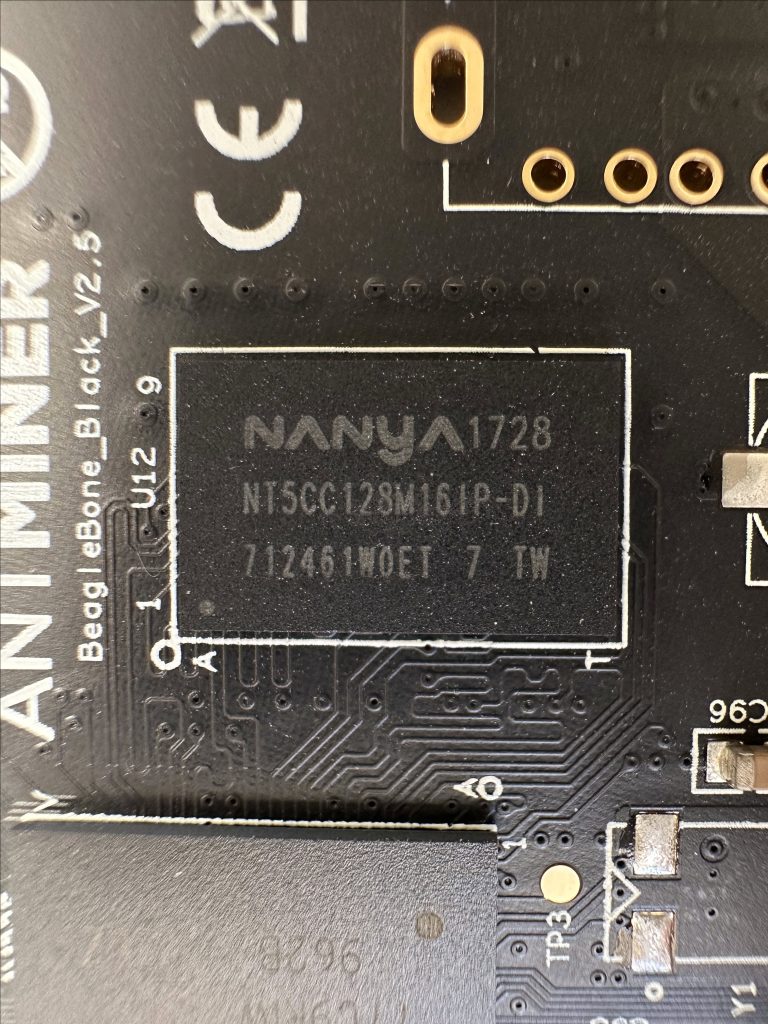
AM3352BZCZI00(ARM Cortex-A8 @ 1.0 GHz, Industrial Grade) - RAM: NANYA
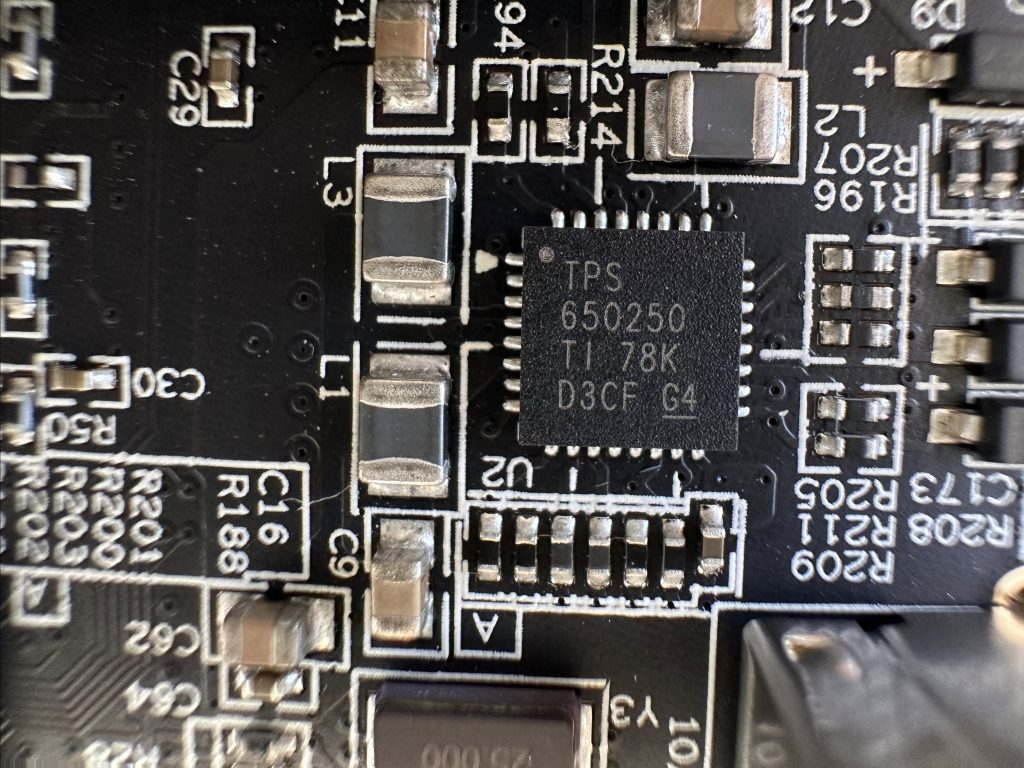
NT5CC128M16IP-DI(256 MB DDR3/DDR3L-1600 SDRAM) - PMIC: Texas Instruments
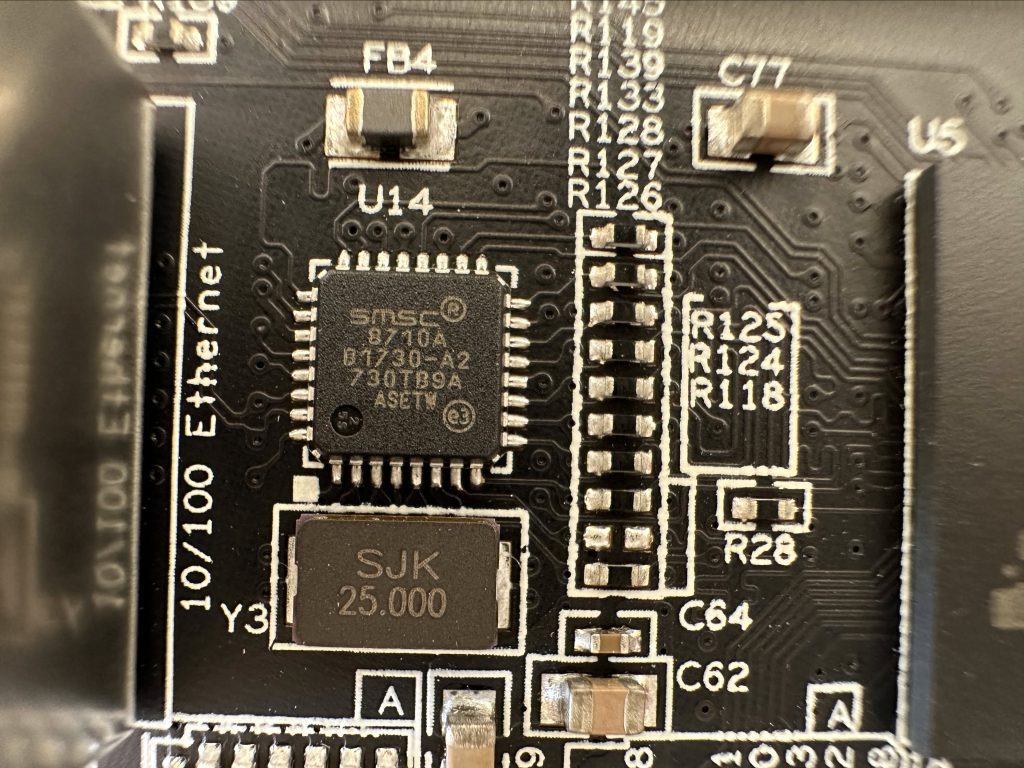
TPS650250integrated power management IC - Ethernet PHY: SMSC / Microchip
LAN8710A10/100 Mbps transceiver with 25.000 MHz crystal - Storage / Boot: MicroSD card slot for firmware flashing, recovery, and Linux OS boot
- CPU / SoC: Texas Instruments Sitara
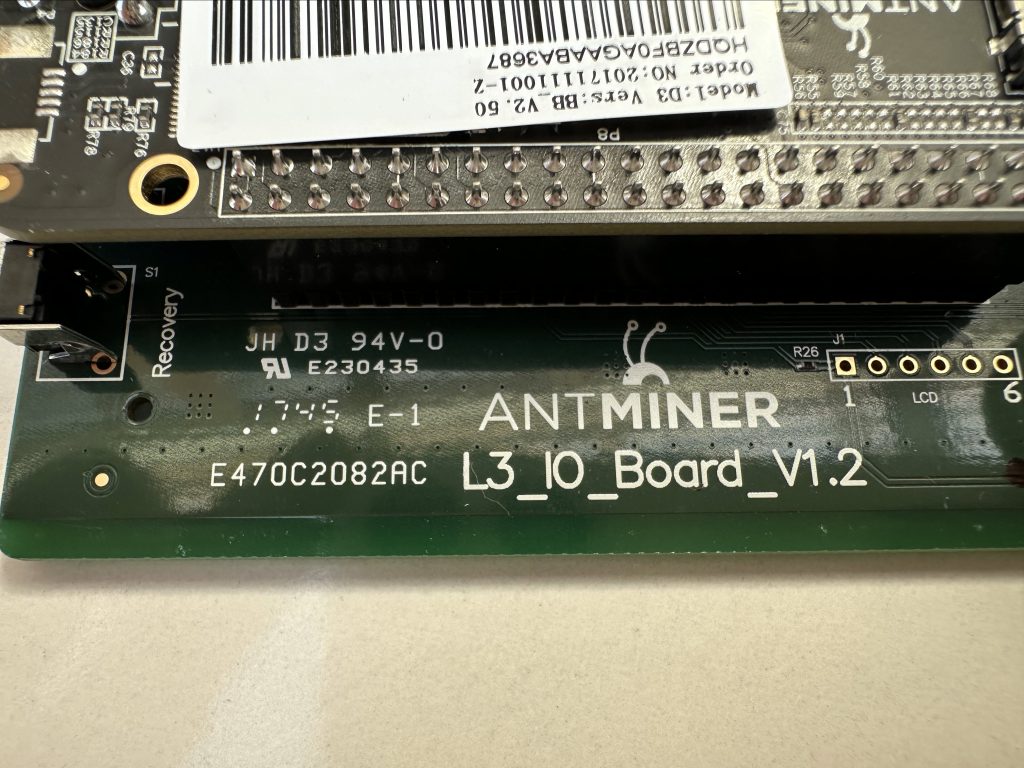
- Base I/O Carrier Board:
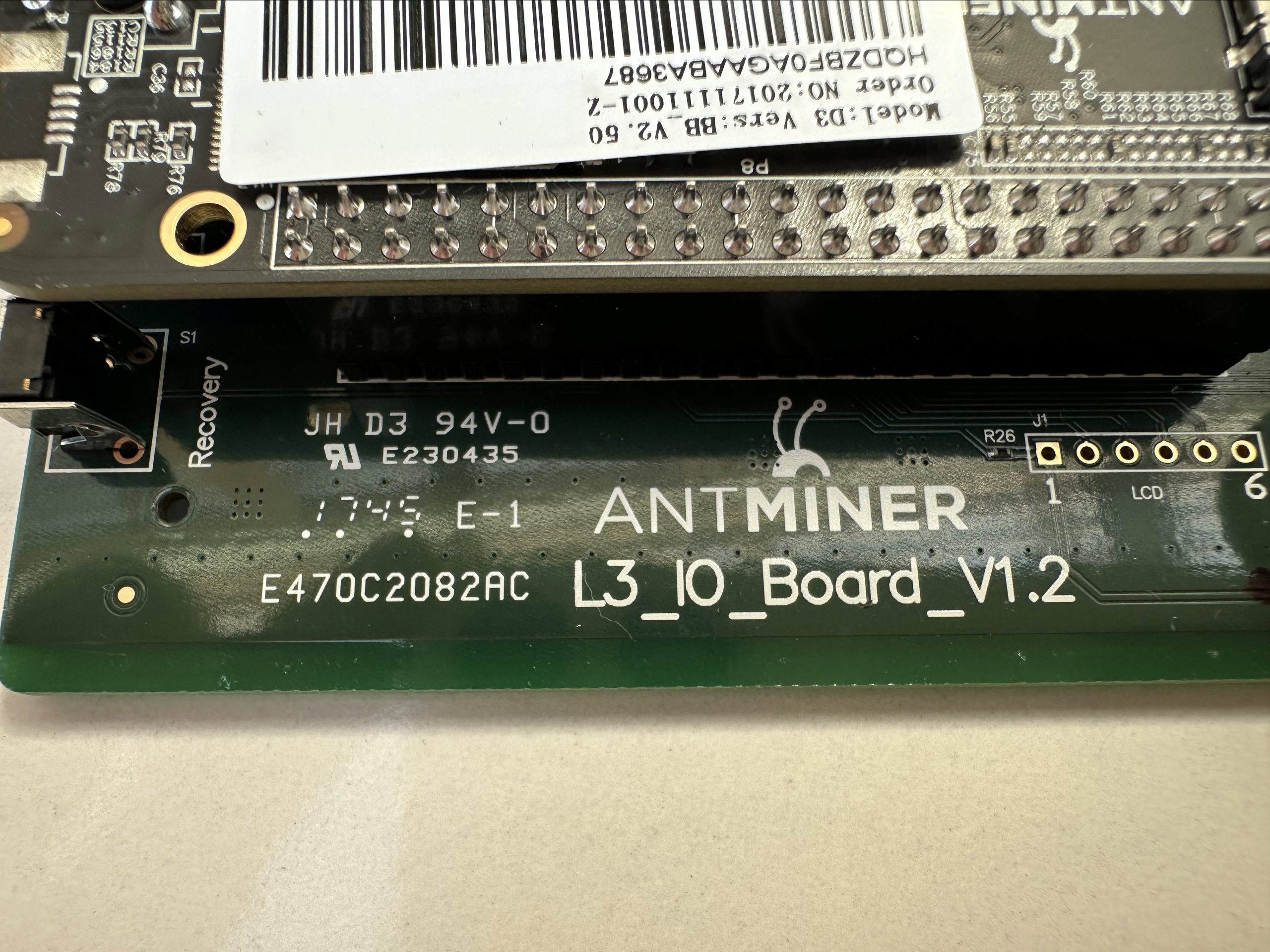
ANTMINER L3_IO_Board_V1.2- 1 × 6-pin PCIe power input connector (
POWER) - 2 × 4-pin PWM fan headers (
FAN1,FAN2) - 3 × 18-pin ribbon cable interfaces to hashboards (
H1,H2,H3) - 1 × 10/100 RJ45 Ethernet port with status LEDs
- Hardware
IP ReportandRecoverypush buttons, Fault (Red) and Normal (Green) status LEDs - Onboard synchronous step-down buck regulators for 5V (
VDD_5V) and 3.3V (D3V3) logic rails with 3 × 270 μF 16V solid polymer capacitors
- 1 × 6-pin PCIe power input connector (
- Processing Module:
- Cooling Fans: 2 × Nidec UltraFlo 120mm × 38mm 4-pin PWM high-RPM brushless fans
- Intake Fan (Front): Nidec UltraFlo
W12E12BS11B5-07(12 V DC, 1.65 A, 19.8 W) - Exhaust Fan (Rear): Nidec UltraFlo
W12E12BS11B5-57(12 V DC, 1.65 A, 19.8 W)
- Intake Fan (Front): Nidec UltraFlo
- Noise Level: ~75 dB to 82 dB under full stock load
- Dimensions & Weight: 320 mm (L) × 130 mm (W) × 190 mm (H) | ~4.3 kg net weight
- DC Input Voltage: 11.60 V to 13.00 V DC
- Power Supply Connectors: 10 × standard 6-pin PCIe connectors (3 per hashboard + 1 for controller IO board)
- Recommended / Compatible PSUs:
- Bitmain APW3 / APW3+ / APW3++: ~1500–1600 W (single PSU sufficient on 220V-240V AC line)
- Bitmain APW5: ~2600 W (supports dual-miner or dual-input configurations)
- Bitmain APW7: ~1800 W high-efficiency server PSU
- Server Breakout PSUs: HP Common Slot 1200W/1400W (DPS-1200FB) with PCIe breakout board
Museum Unit Physical Traceability & Serials
| Component | Model / Hardware Silkscreen | Unit Barcode / Serial | Batch / Work Order |
|---|---|---|---|
| Chassis Unit | ANTMINER D3 (19.3G Variant) | HQDZ71DAGAABA3687 |
20171111001-Z |
| Base I/O Board | ANTMINER L3_IO_Board_V1.2 |
HQDZI20AGAABA3687 |
20171111001-Z (Date Code: 1745) |
| BeagleBone CPU Board | BeagleBone_Black_V2.5 (TI AM3352) |
HQDZBF0AGAABA3687 |
20171111001-Z (Date Code: 1728) |
| Hashboards (3×) | D3_DashBoard_V2.2 (180× BM1760) |
HQDZYHDAGAABA3687 |
20171111001-Z (Date Code: 1745) |
Blissz D3 Firmware (Custom Firmware Tuning)
The community-developed Blissz D3 Custom Firmware unlocks advanced per-chain frequency scaling, voltage domain step reduction, and adaptive temperature-controlled fan profiles for maximum efficiency:
| Firmware / Profile Mode | Hashrate | Operating Frequency | Wall Power | Efficiency | Acoustic Profile |
|---|---|---|---|---|---|
| Stock Bitmain Reference | 19.3 GH/s | 537 MHz | ~1,350 W | 0.070 J/MH | Very Loud (~78–82 dB) |
| Blissz High Efficiency | 19.0 – 19.3 GH/s | 500 – 525 MHz | 950 – 1,100 W | 0.050 – 0.057 J/MH | Moderate (~65–70 dB) |
| Blissz Low Power / Silent | 15.0 – 17.0 GH/s | 400 – 460 MHz | 700 – 780 W | 0.045 – 0.048 J/MH | Quiet-Moderate (~55–62 dB) |
| Blissz Ultra Eco / Whisper | 12.0 – 14.0 GH/s | 325 – 375 MHz | 500 – 580 W | 0.041 – 0.043 J/MH | Whisper (custom shroud) |
Documentation & Guides
- ZeusBTC Repair Guide: Diagnostic test points (0.8V core, 1.8V PLL, 3.3V IO, RST, CLK, RI, RO signals, and PIC microcontroller flashing).
- Bitmain Official Support: MicroSD unbrick and recovery procedure for BeagleBone Black controller board.
- Bitcointalk Community Knowledge: Blissz custom firmware setup, ASIC voltage drop optimizations, and fan spoofer pinouts.
- Critical Pre-Power Safety Rule: Always inspect all heatsinks before applying power. If any clip-on heatsink has fallen off, operating the board will cause instantaneous BM1760 chip thermal burn-out.
Future Project Ideas / Repurposing
- Project “Silent D3” (Ambient Lab Build): Replace the screaming 1.65A Delta/Nidec fans with 3D-printed 120mm-to-140mm duct adapters and dual Noctua NF-A14 industrialPPC PWM fans, running Blissz firmware at 400 MHz (700W draw) with inline PWM RPM spoofers.
- Project “Efficiency Curve Benchmark” (300–537 MHz Sweep): Systematically step core clock frequencies from 300 MHz to 537 MHz in 25 MHz increments while logging AC active power, power factor, and THD via a calibrated digital power analyzer to map the BM1760 voltage-frequency Pareto curve.
- Project “Controllable Space Heater” (Smart Thermostat Integration): Integrate the miner with Home Assistant via the cgminer TCP socket API (port 4028) to dynamically adjust hashing and thermal heat output between 500W and 1,350W based on room ambient sensors and home solar PV surplus.
- Project “Ducted Window Exhaust”: Build a 120mm-to-100mm flexible duct assembly to route hot exhaust air directly outdoors during warm weather.
- Project “Immersion Cooling Pilot”: Submerge the 3 hashboards in dielectric synthetic hydrocarbon cooling fluid in a transparent acrylic display tank for a zero-fan, zero-noise interactive museum exhibit.
- Project “Local X11 P2Pool / Testnet Node”: Host a private local Dash/X11 regtest/testnet node on the Proxmox cluster and point the D3 at the local pool to demonstrate real-time Proof-of-Work block generation, nonce discovery, and difficulty retargeting.
- Project “Power Measurement Ladder”: Instrument each of the 10 PCIe 6-pin power feeds with Hall-effect current sensors (ACS712 / INA226) and an ESP32 logger to graph per-hashboard VRM power draw in real time.
- Project “Hashcat v7 Assimilation Bridge Research”: Research custom command-injection interfaces to the BM1760 ASIC pipeline over SPI/UART for accelerated non-cryptocurrency X11 round hashing analysis.