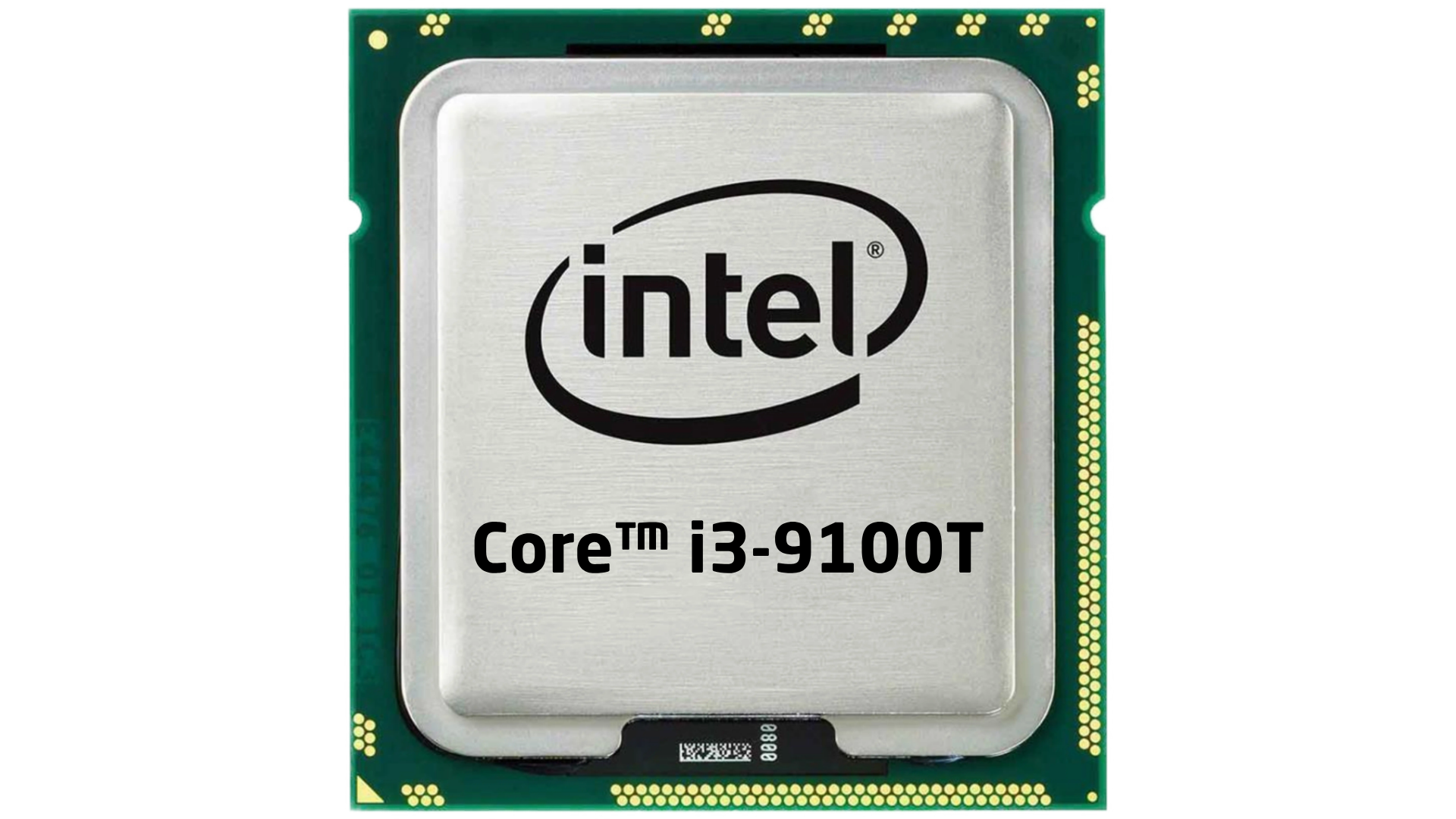
Intel Core i3-9100T Processor
•
Microarchitecture: Coffee Lake Refresh (14 nm++)
•
Socket: Socket LGA 1151 (LGA 1151v2 / 300 Series)
•
Museum Inventory: 1 Unit (Installed in HP ProDesk 400 G5 Desktop Mini • S-Spec: SRCZX)
•
Source Authority: TechPowerUp, Intel & PassMark
1. Technical Overview & Key Specifications
| Category | Property | Specification |
|---|---|---|
| Processor Identity | Model Name | Intel® Core™ i3-9100T (SKU: CM8068403377713 • PassMark ID: 3488) |
| Microarchitecture | Coffee Lake Refresh (9th Generation Core) | |
| Market Segment | Desktop / Ultra-Compact Form Factor (UCFF) / Energy-Efficient Edge Node | |
| Launch Date | April 23, 2019 (Q2’19 Release • Production Status: End-of-Life) | |
| Part Numbers / S-Spec | SRCZX (OEM / Tray: CM8068403377713 • Verified Museum Inventory: 1 unit) |
|
| Physical & Manufacturing | CPU Socket | Socket LGA 1151 (LGA 1151v2 revision, 300-series chipsets only) |
| Fabrication Process | 14 nm++ (Intel 14-nanometer tri-gate FinFET optimization) | |
| Transistor Count | Approx. 1.75 Billion transistors (Monolithic 4-core die) | |
| Die Size & Package Area | 126 mm² die area • 37.5 × 37.5 mm LGA package envelope | |
| Silicon Stepping | B0 Stepping (Native quad-core die layout) | |
| Thermal Junction / Case | 100°C (tJMax) • 72°C (tCaseMax) | |
| Cores & Performance | Physical Cores / Threads | 4 Cores / 4 Threads (1 thread per core, non-SMT design) |
| Base Operating Frequency | 3.10 GHz | |
| Max Turbo Boost Frequency | Up to 3.70 GHz (Intel Turbo Boost Technology 2.0) | |
| Base Clock / Multiplier | 100 MHz BCLK / 31.0× (Multiplier Locked) | |
| Bus Interconnect Speed | 8.0 GT/s DMI 3.0 (Direct Media Interface to PCH) | |
| Multi-CPU Scalability | Single Socket (1S Only) | |
| Thermal & Electrical | Thermal Design Power (TDP) | 35 W (T-Series Ultra-Low Power Profile) |
| Configurable TDP-down | 25 W @ 2.40 GHz base clock | |
| Core Voltage Range | Dynamic VID (0.65 V – 1.20 V) | |
| Cache Hierarchy | Level 1 (L1) Cache | 4 × 32 KB Data + 4 × 32 KB Instruction (256 KB total L1) |
| Level 2 (L2) Cache | 4 × 256 KB dedicated unified cache (1,024 KB / 1 MB total L2) | |
| Level 3 (L3) Cache | 6 MB Intel® Smart Cache (shared pool across 4 cores, 12-way set associative) | |
| Memory Controller | Memory Architecture | Dual-Channel DDR4 interface (2 memory channels, up to 2 DIMMs per channel) |
| Rated Memory Speed | Up to DDR4-2400 MT/s | |
| Maximum Memory Bandwidth | 38.4 GB/s (At native DDR4-2400 rating) | |
| Max Capacity & ECC Support | Up to 64 GB (up to 128 GB with high-density modules) • ECC Supported: Yes | |
| Museum Host Installed RAM | 64 GB (2 × 32 GB) DDR4 SODIMM (Corsair Vengeance CMSX64GX4M2A3200C22 running at 2400 MT/s) | |
| Expansion & Graphics | PCI Express Interface | PCIe 3.0 (16 Lanes from CPU: 1×16, 2×8, or 1×8 + 2×4 configurations) |
| Integrated Graphics Solution | Intel® UHD Graphics 630 (Gen9.5 GT2, 24 Execution Units • 350 MHz base / 1100 MHz dynamic) | |
| Display & Media Engine | DisplayPort 1.2 (4K @ 60Hz), HDMI 1.4 (4K @ 24Hz) • Intel Quick Sync Video, Clear Video HD | |
| PassMark Benchmarks | Average CPU Mark (Multithread) | 5,632 (Median: 5,875 across 283 samples • Personal Local Baseline: 6,109) |
| Single Thread Rating | 2,116 MOps/Sec (PassMark PerformanceTest V10) | |
| Desktop CPU Category Rank | Rank #632 out of 1,588 Desktop CPUs in PassMark database |
2. Silicon Topology & Coffee Lake Monolithic Architecture
Silicon Scale
1.75B
Transistors on monolithic 14nm++ B0 stepping die
Execution Engines
4 Cores / 4 Threads
Quad physical cores (3.10 GHz base / 3.70 GHz turbo)
Cache & Graphics
6MB L3 / UHD 630
Bi-directional ring bus + 24 EU Quick Sync graphics
Internal Silicon Die Topology & Ring Interconnect Bus
+---------------------------------------------------------------------------------------------------+
|                     INTEL CORE i3-9100T MONOLITHIC SILICON TOPOLOGY (COFFEE LAKE)                 |
|                                                                                                   |
|  +-----------------------------+  +------------------------------------------------------------+  |
|  |   INTEGRATED GRAPHICS CORE  |  |                     COMPUTE CORES & CACHE                  |  |
|  |                             |  |                                                            |  |
|  |   Intel UHD Graphics 630    |  |   +-------------+  +-------------+  +------------------+   |  |
|  |   - Gen9.5 Architecture     |  |   |   CORE 0    |  |   CORE 1    |  |  SYSTEM AGENT    |   |  |
|  |   - 24 Execution Units (EUs)|  |   | 32K+32K L1  |  | 32K+32K L1  |  | - PCIe 3.0 x16   |   |  |
|  |   - Up to 1,100 MHz Boost   |  |   |   256K L2   |  |   256K L2   |  | - DMI 3.0 link   |   |  |
|  |   - Quick Sync Video Engine |  |   +------+------+  +------+------+  +--------+---------+   |  |
|  |   - 4K Display Controller   |  |          |                |                  |             |  |
|  +--------------+--------------+  |   === ring stop ======== ring stop ====== ring stop ===+   |  |
|                 |                 |   ||     |                |                  |         ||  |  |
|                 |                 |   ||  1.5MB L3         1.5MB L3           1.5MB L3     ||  |  |
|                 |                 |   ||                                                   ||  |  |
|                 +======================>  BI-DIRECTIONAL RING INTERCONNECT (6 MB L3 POOL)  ||  |  |
|                                   |   ||                                                   ||  |  |
|                                   |   ||  1.5MB L3         1.5MB L3           1.5MB L3     ||  |  |
|                                   |   ||     |                |                  |         ||  |  |
|                                   |   === ring stop ======== ring stop ====== ring stop ===+   |  |
|                                   |          |                |                  |             |  |
|                                   |   +------+------+  +------+------+  +--------+---------+   |  |
|                                   |   |   CORE 2    |  |   CORE 3    |  | DUAL DDR4 IMC    |   |  |
|                                   |   | 32K+32K L1  |  | 32K+32K L1  |  | - 2400 MT/s Rate |   |  |
|                                   |   |   256K L2   |  |   256K L2   |  | - ECC Supported  |   |  |
|                                   |   +-------------+  +-------------+  +------------------+   |  |
|                                   +------------------------------------------------------------+  |
+---------------------------------------------------------------------------------------------------+
3. Dual-Channel DDR4 Memory & High-Speed Bus Interconnect
Integrated Dual-Channel DDR4 Controller
- Memory Architecture: Integrated 128-bit dual-channel memory controller (2 discrete 64-bit channels).
- Rated Speed: Officially rated up to DDR4-2400 MT/s, delivering up to 38.4 GB/s theoretical memory bandwidth.
- Enterprise ECC Support: Full hardware Error-Correcting Code (ECC) engine supported when paired with compatible Intel workstation/server chipsets (C246).
- Museum Host Deployment: Equipped with 64 GB (2 × 32 GB) Corsair Vengeance DDR4-3200 SODIMM modules operating at native 2400 MT/s low-power envelope.
Direct Media Interface & Expansion Fabric
- High-Speed PCH Link: DMI 3.0 interconnect operating at 8.0 GT/s (approx. 3.93 GB/s per direction) linking the CPU directly to the Intel B360 chipset.
- Direct PCIe Root Complex: 16 native PCI Express 3.0 lanes direct from the CPU die for high-performance discrete graphics or PCIe storage add-in cards.
- Ultra-Low Latency Ring: Coherent ring interconnect links all 4 compute cores, 6 MB L3 cache slices, memory controller, and UHD 630 graphics with single-cycle hops.
- Thermal Throttling Protection: Thermal Monitoring Technologies (TM1, TM2) and Digital Thermal Sensors (PECI) ensure safe operation within 35W envelope.
4. Advanced Technologies, Virtualization & Platform Security
| Technology Category | Feature / Instruction Set | Functional Capability |
|---|---|---|
| Hardware Virtualization | Intel® VT-x with EPT | Hardware virtualization assistance with Extended Page Tables (EPT) and Virtual Processor IDs (VPID) for rapid hypervisor context switching in Proxmox VE 9.2.11 |
| Intel® VT-d (IOMMU) | Directed I/O virtualization enabling full PCI passthrough (NVMe SSDs, network NICs, iGPU) to guest virtual machines with interrupt remapping | |
| Intel® TSX-NI | Transactional Synchronization Extensions for accelerating multithreaded database operations and lock-free concurrency algorithms | |
| Vector & Cryptographic Acceleration | Intel® AES-NI & SHA | Hardware-accelerated AES encryption achieving 1,734 MB/s sustained throughput for encrypted storage pools and line-rate WireGuard tunnels |
| AVX2 & FMA3 (256-bit SIMD) | Advanced Vector Extensions 2 and Fused Multiply-Add 3 providing 256-bit floating point and integer execution for media transcoding and scientific compute | |
| Intel® Quick Sync Video | Dedicated fixed-function hardware video encoding and decoding for H.264/AVC, H.265/HEVC (8-bit and 10-bit), VP9, and VC-1 in Plex/Immich containers | |
| Platform Security & Power | Intel® SGX & OS Guard | Software Guard Extensions enclave execution and Supervisor Mode Execution Protection (SMEP) preventing privilege escalation attacks |
| Intel® Turbo Boost 2.0 | Dynamic opportunistic clock scaling boosting all active cores up to 3.70 GHz within thermal and electrical headrooms | |
| Energy-Efficient 35W Profile | T-Series low-power envelope allowing 24/7 homelab operation with minimal power draw and whisper-quiet acoustic footprint |
5. PassMark Benchmark Dossier & Synthetic Performance (PerformanceTest V10)
Multithread Rating (CPU Mark)
5,632
Median: 5,875 across 283 samples • Local Host Test: 6,109
Single Thread Rating
2,116
MOps/Sec • Solid single-core response at 3.70 GHz peak boost
Data Encryption (AES-NI)
1,734
MBytes/Sec sustained hardware cryptographic rate
PassMark PerformanceTest V10 Detailed Test Suite Results
| Test Suite Routine | Average Result Metric | Operational Context |
|---|---|---|
| Integer Math | 14,892 MOps/Sec | General OS kernel execution, database processing, and hypervisor overhead |
| Floating Point Math | 12,886 MOps/Sec | Numeric calculations, scientific modeling, and multimedia transformations |
| Find Prime Numbers | 25 Million Primes/Sec | Pure integer execution pipeline throughput and branch prediction efficiency |
| Random String Sorting | 9,205 Thousand Strings/Sec | DDR4 memory controller bandwidth and L3 cache indexing responsiveness |
| Data Encryption | 1,734 MBytes/Sec | Hardware AES-NI encrypted NVMe storage & high-throughput WireGuard tunnels |
| Data Compression | 74,688 KBytes/Sec | ZFS LZ4/ZSTD compression and Proxmox backup deduplication throughput |
| Physics Simulation | 422 Frames/Sec | Multi-threaded kinematics and vector transformation throughput |
| Extended Instructions | 6,622 Million Matrices/Sec | Intel AVX2 and FMA3 256-bit matrix vectorization throughput |
| Single Thread Performance | 2,116 MOps/Sec | Single-core Coffee Lake responsiveness at 3.70 GHz peak turbo clock |
PassMark Relative Hierarchy: Desktop Energy-Efficient & Sibling Stack
| Processor Model | Cores / TDP | Average CPU Mark | Relative Variance |
|---|---|---|---|
| Intel Core i5-9400F | 6C / 6T • 65W | 9,463 | +68.0% |
| Intel Core i5-9400T | 6C / 6T • 35W | 7,690 | +36.5% |
| Intel Core i3-9300T | 4C / 4T • 35W | 5,850 | +3.9% |
| Intel Core i3-9100T (Exhibit) | 4C / 4T • 35W | 5,632 | Baseline (0.0%) |
| Intel Core i7-2600 | 4C / 8T • 95W | 5,483 | -2.6% |
| Intel Core i3-8100T | 4C / 4T • 35W | 5,340 | -5.2% |
| Intel Core i5-4460 | 4C / 4T • 84W | 4,916 | -12.7% |
| Intel Core i3-7100 | 2C / 4T • 51W | 4,308 | -23.5% |
6. Platform Synergy: Pairing with HP ProDesk 400 G5 Desktop Mini
Seamless Architectural Integration
The Intel Core i3-9100T is the silicon heart of the HP ProDesk 400 G5 Desktop Mini cataloged in Exhibit #2871. Paired with HP’s Mandolin-R motherboard (HP 859C) on the Intel B360 Express chipset, this compact 1-liter chassis provides dense virtualization compute at exceptional power efficiency:
| Hardware Interface | Intel Core i3-9100T | HP ProDesk 400 G5 Desktop Mini (Post #2871) |
|---|---|---|
| CPU Socket & Chipset | Socket LGA 1151 (LGA 1151v2) | HP 859C System Board with Intel® B360 Express Chipset |
| Memory Architecture | Dual-Channel DDR4 (up to 2400 MT/s) | 64 GB DDR4-2400 SDRAM (Dual SODIMM: Corsair Vengeance 2 × 32 GB) |
| Storage Subsystem | PCIe 3.0 root lanes & DMI 3.0 link | 512 GB Kingston OM8PJP4512K3-AH0 NVMe M.2 SSD + 512 GB Verbatim Vi560 SATA SSD |
| Display & Media Engine | Intel UHD Graphics 630 (DP 1.2 / HDMI 1.4) | Dual DisplayPort 1.2 ports + 1 VGA port driving multi-monitor displays |
| Hypervisor Support | Intel VT-x (EPT) & Intel VT-d (IOMMU) | Proxmox VE 9.2.11 hypervisor node i3 hosting Immich VM 102 |
| Power & Thermodynamics | 35W Base TDP / 25W cTDP-down | External 65W HP power supply (up to 89% efficiency) in 17.7 × 17.5 × 3.4 cm chassis |
7. Curator’s Assessment & Homelab Applicability
- Museum Hardware Provenance: Mateo’s Museum archive preserves 1 verified physical unit of the Intel Core i3-9100T processor (OEM Part:
CM8068403377713, S-Spec:SRCZX, B0 stepping). The processor is in active operational deployment inside the HP ProDesk 400 G5 Desktop Mini (Product:8VR69ES#BCM, S/N:8CC0270RP8), functioning as the authoritative Proxmox hypervisor nodei3in the CZ-BRN-NEU infrastructure cluster. - Exceptional Compute-Per-Watt Profile: Operating at a strict 35 W TDP (with a 25W cTDP-down option), the i3-9100T delivers true quad-core desktop performance within a micro-chassis thermal budget. With an Average CPU Mark of 5,632 (and a local benchmark of 6,109), it comfortably outpaces previous-generation 95W quad-core CPUs such as the Core i7-2600 (5,483) and 84W Haswell Core i5-4460 (4,916).
- Dedicated Media & Immich Workload Node: Integrated Intel UHD Graphics 630 features Gen9.5 Quick Sync Video with native hardware decoding/encoding for HEVC (8-bit and 10-bit) and VP9. Inside Proxmox node
i3, this enables GPU passthrough to Immich VM 102, accelerating photo indexing, facial recognition, and thumbnail generation with zero CPU contention. - Massive 64 GB Memory Density: While standard retail specifications reference 64 GB support, the memory controller reliably operates two 32 GB Corsair Vengeance DDR4 SODIMMs in dual-channel configuration, providing ample RAM headroom for Linux kernel caching, ZFS buffers, and concurrent guest services.
- Enterprise Virtualization (VT-x / VT-d): Robust virtualization primitives with EPT and IOMMU allow full isolation of virtual machines and hardware passthrough of storage controllers and network adapters, making this compact Coffee Lake chip a dependable, quiet workhorse for edge infrastructure.
8. Authentic Hardware Photography & Physical Artifacts
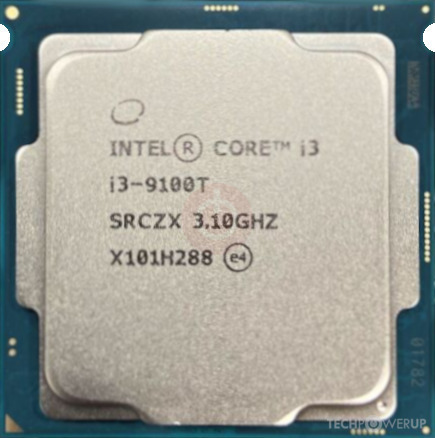
Physical Processor Die Top • S-Spec SRCZX (3.10 GHz, Coffee Lake B0 Stepping)
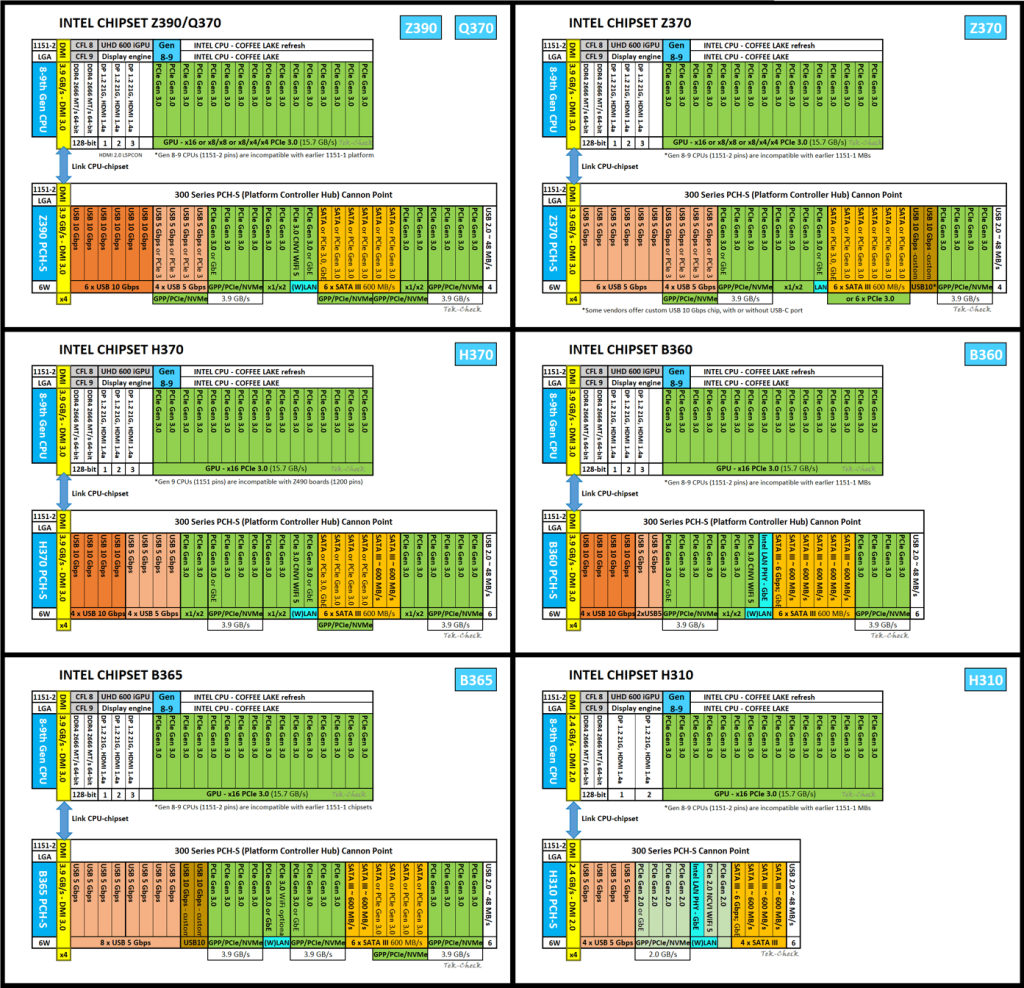
LGA 1151 Socket Architecture & Power Pin Delivery Map
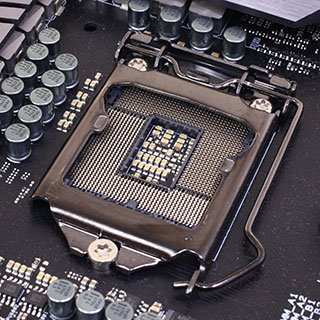
Physical Socket 1151 Retaining Mechanism & Gold Pins